

Where the Wild Things Are — for Now
“What a country chooses to save is what a country chooses to say about itself.”
—Mollie Beattie, Director, U.S. Fish and Wildlife Service
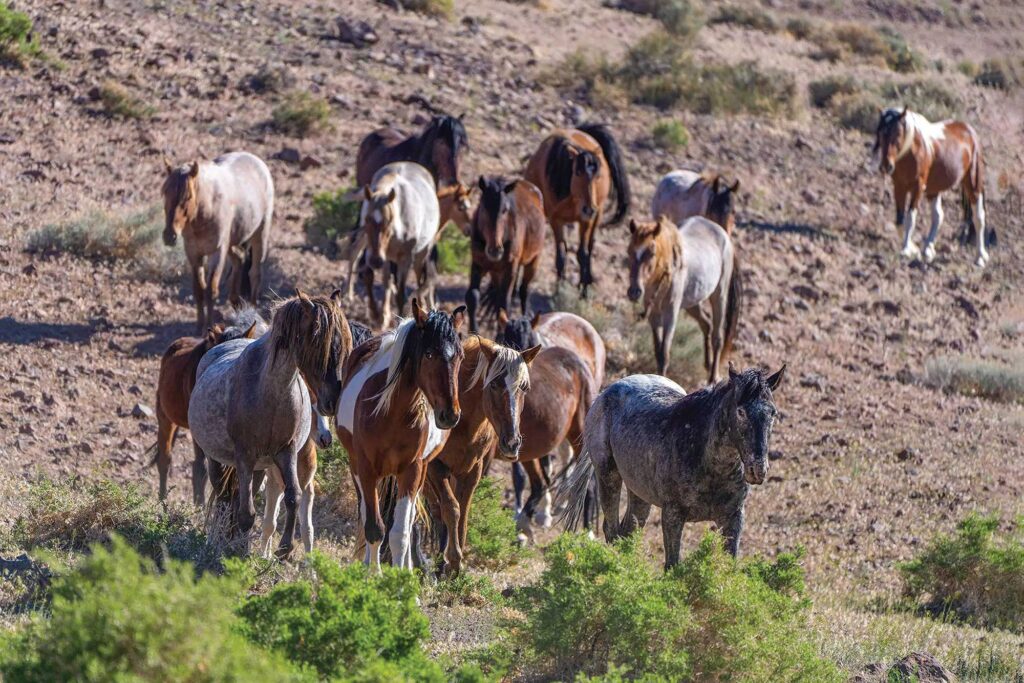
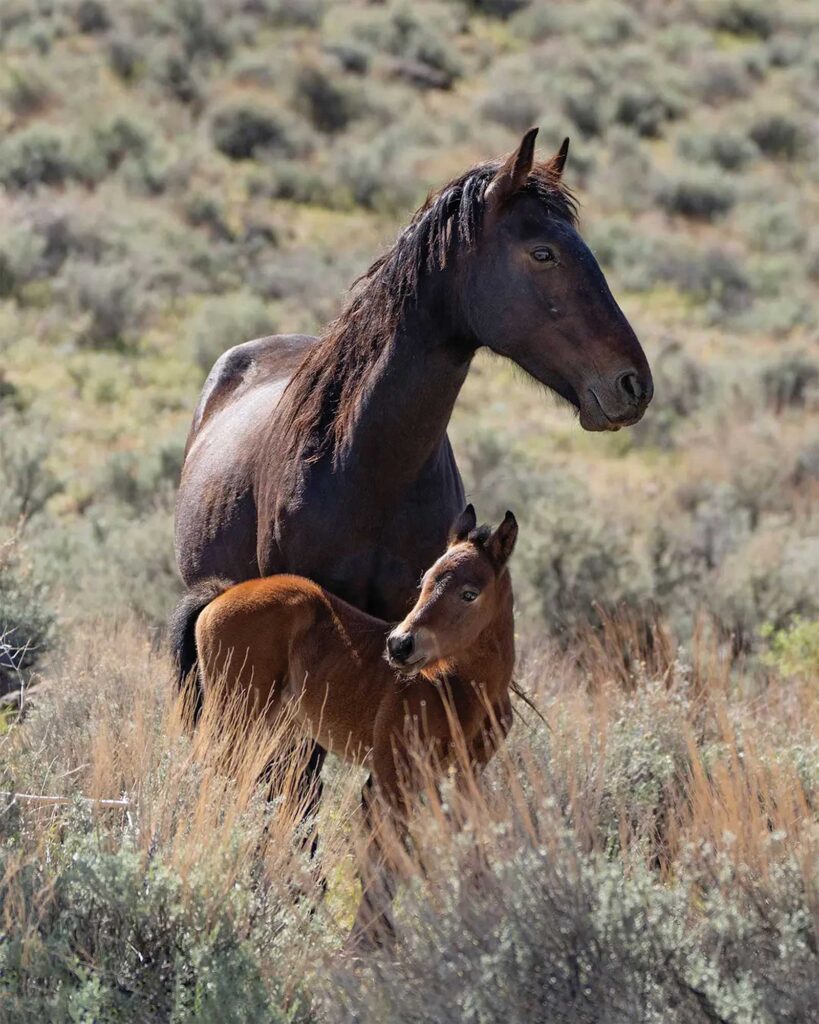
Wild Horses. The words tap into a deep well of emotion. Their unbridled wildness, grace and struggles remind us of what humans have taken away from the animals we’ve domesticated over thousands of years.
The reality faced by many is something else entirely: flight, eyes wide, chased by low-flying helicopters. The Forest Service and Bureau of Land Management (BLM), charged with protecting these horses and their habitats, use helicopters to drive them into pens for removal to off-range holding facilities. It’s a controversial and dangerous operation, but hardly the most worrisome chapter in their lives.
The BLM rejects claims that helicopter gathers are inhumane, arguing they are safe and sometimes preferable for moving large herds across rugged terrain. University of Wyoming researcher John Derek Scasta analyzed 70 federal gathers involving approximately 29,000 horses and 2,000 burros between 2010 and 2019. Reported capture mortality was no higher with helicopters than with bait trapping, and injury-related deaths were uncommon in both. But the study didn’t establish whether horses suffer psychological trauma. Physical safety and psychological safety aren’t necessarily the same thing.
Who’s in Charge Here?
The Forest Service and BLM manage 229 wild horse and burro territories across 26.6 million acres of public lands. BLM estimates indicate populations peaked around 95,000 animals in 2020 and stood near 85,000 in 2026.
In 1971, President Richard Nixon signed the Wild Free-Roaming Horses and Burros Act. Its language was explicit: “…Congress finds and declares that wild free-roaming horses and burros are living symbols of the historic and pioneer spirit of the West; that they contribute to the diversity of life forms within the Nation and enrich the lives of the American people; and that these horses and burros are fast disappearing from the American scene. It is the policy of Congress that wild free-roaming horses and burros shall be protected from capture, branding, harassment, or death…”
Yet the agencies’ increasingly convoluted management strategies have produced a system in which protection, removal and long-term confinement coexist.
Horses and Burros vs. Cattle
Horses and burros aren’t alone on federal grazing lands. According to Taxpayers for Common Sense (TCS), 62 percent of BLM lands and 49 percent of Forest Service lands are available to private ranchers at extraordinarily generous rates. American taxpayers, in effect, subsidize ranchers whose cattle graze on public land.
Federal grazing fees are calculated by Animal Unit Month (AUM), roughly the forage consumed by a cow and calf in one month. The 2026 federal rate is $1.69 per AUM, compared with an average $23.40 on private lands in 2024. In 2017, administering the federal grazing program cost the BLM more than $32 million, while livestock operations paid just over $18 million in fees.
TCS concludes that the system benefits a small segment of the livestock industry at substantial taxpayer expense. The horses-versus-cattle debate is often characterized as a zero-sum competition. Patricia Miller, executive director of the American Wild Horse Conservancy (AWHC), sees it differently. “I value the Western way of life and understand what is at stake for ranching communities,” she says. “I also believe ranchers can be essential partners in building a better approach. We want to work together on humane fertility control, habitat stewardship, and practical solutions that support wild horses, wildlife, working landscapes, and taxpayers.” She advocates collaboration rather than confrontation, guided by “sound science, fair resource allocation and meaningful protection for the horses Congress entrusted the government to preserve.”
Reevaluate the Formula, or Reimagine the Law?
Now, forces within the federal policy apparatus are advocating something far more consequential: removing some protections afforded wild horses.
Project 2025, the governing roadmap prepared by the Heritage Foundation before President Trump’s second term, acknowledges BLM efforts to expand adoption, gathers, holding capacity and fertility control. Then it concludes: “All of that will not be enough to solve the problem, however. Congress must enact laws permitting the BLM to dispose humanely of these animals.”
Meanwhile, existing law allows the BLM to sell horses to private buyers. Its stated objective is placement in “loving homes,” and horses are offered through federal adoption programs. But a recent New York Times investigation revealed what can happen when animals move from adoption into the sales system.
Horses may be offered for adoption three times before becoming eligible for sale. Adopted horses retain federal protections against slaughter. Sold horses lose those protections, although buyers must agree not to slaughter them or knowingly transfer them for that purpose. Subsequent resale, however, makes accountability difficult. The Times documented more than 60 horses purchased for $25 apiece by an Ohio buyer. The following night, two double-decker cattle trucks arrived, loaded the mustangs and disappeared. Canadian border livestock records revealed that some federally sold horses ultimately reached slaughter plants.
AWHC’s investigative work helped establish the foundation for the Times reporting through federal sales records and identification of former BLM horses in kill pens. “That raises serious questions about whether the protections in place are being effectively enforced,” Miller says. She supports responsible adoption but insists government policy must be distinguished from what actually happens after animals leave federal custody. AWHC advocates stronger buyer screening and a $500 minimum sale price.
Birth Control vs. Killing Horses
Former acting BLM director William Perry Pendley wrote Project 2025’s wild-horse chapter. His conclusion that the system ultimately needs authority to kill horses overlooks another available tool: fertility control.
Immunocontraceptive drugs can be administered remotely by dart gun, controlling herd growth while allowing horses to remain on the range with their family bands. They’re relatively inexpensive and minimally invasive.
Miller supports reversible treatments such as PZP but emphasizes that success requires sustained application, sufficient coverage and careful monitoring. “AWHC operates the world’s largest wild horse fertility control program on Nevada’s Virginia Range and more than 20 other programs operate across the country.”
The USDA recently approved a $30 million investment in BLM fertility-control efforts.
Miller applauds the funding while acknowledging legitimate ecological concerns. “Where horses are contributing to degradation, we support responsible, humane management. That is precisely why we advocate sustained fertility control and habitat stewardship, to protect the land and the animals before conditions become a crisis.” She adds: “Acknowledging ecological impacts does not mean accepting repeated helicopter roundups and long-term holding as the only solution.”
Doing the Right Thing
The Forest Service website attempts, rather strangely, to temper public sentiment by reminding readers that wild horses aren’t necessarily as beautiful as television and film suggest. Those magnificent, mane-flying mustangs, it explains, are often equine actors selected for their appearance. But beauty was never supposed to be the threshold for protection.
The question is whether the BLM and Forest Service have created a system that fulfills Congress’s promise in 1971. Protecting wild horses and burros needn’t mean ignoring ecological realities or the needs of ranching communities. Responsible grazing, fertility control, habitat stewardship, adoption and, when necessary, removal can coexist. But the starting point must be recognition of the animals’ intrinsic worth, and an honest examination of a system that allows horses to be chased from the range, confined indefinitely at taxpayer expense or sold for almost nothing into a marketplace where federal protections become increasingly difficult to enforce.
Mollie Beattie, the first female director of the U.S. Fish and Wildlife Service, understood the significance of those choices.
“What a country chooses to save is what a country chooses to say about itself.”