
More Than Bone Deep
When the spirit is willing but the body has questions, a lifelong rider negotiates the risks.
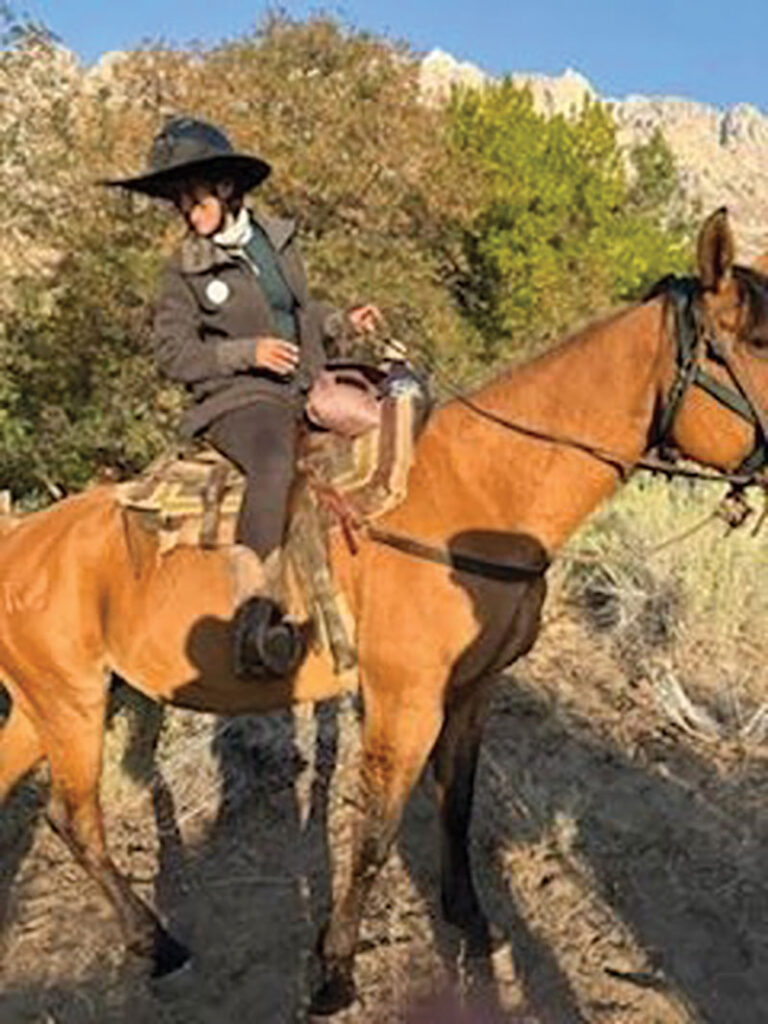
A year ago, I booked a trip out west to help drive a herd of mules and horses to their winter pasture. It was a calculated risk. I checked the box that said “Advanced rider.” But I also checked the one that said “calm horse,” not “spirited;” and another that said “Walk and trot only,” not “Canter and gallop.”
You know it was hard to check those boxes. I’d seen the photos. High desert, big sky, western saddles, lots of dust. A huge herd of loose animals, rushing towards their vacation grounds, mounting excitement.
Checking those boxes was my way of doing something I probably should not be doing at all: continuing to ride after an osteoporosis diagnosis and a broken elbow from a bike fall.
A lot of us have osteoporosis of various levels. About 8 million women and 2 million men in the U.S., according to federal government statistics. It means our bones are porous and particularly subject to fracture. It generally means we should eat more calcium and lift more weight. It may mean we take drugs. For riders, it means we each have to weigh the risk of riding. It’s not just the risk of falling, it’s also the risk of compression on the spine from the horse’s gait beneath us.
Doctors, Reddit threads, and horse people are all divided on the subject. The “Yes with precautions” faction recommends a gaited horse and a shock absorbing saddle pad. A few say that riding strengthens the spine, so hop on. On the other end is the “No way” faction: nope, not worth the risk.
Me, I waver. Cycling was a lifelong hobby too, but it was easy to give up the bike. Riding horses, though, that’s different. No one swoons from the smell of walking into a bike store.
So I booked that mule drive and bought a big Western brim for my English helmet. I looked like a straight up dork but it gave me a modicum of peace. I got a tall chestnut mare named Jodie, easily 16.1 hands. If I fell from that height, my bones would vaporize. But this particular outfit took beginners, so I figured I’d slot in with them and hope Jodie didn’t hit a hole and roll us both.
The group leader had some terse advice for us “Don’t fall off.” Off we went, up steep rocks and across dusty plains in the Sierra Nevada mountains. Nobody fell. The horses were strong and steady after a season of conditioning. We, the riders, were less conditioned. After 6 to 8 hours a day in the saddle, four days in a row, my spine was fine but my thighs had concerns.
The low point was when the handful of beginners and I were trucked ahead to the campsite while the advanced riders rounded up the eager herd, now 80 strong, for the fastest leg. The riders returned exhilarated, exhausted and unrecognizable from galloping after breakaways, including the now riderless Jodie. One was a petite woman in her early 70s who had osteoporosis. “You should have come!” she told me.
Next time, I thought. Next time.
Joyce Lombardi currently does unmounted barn chores at a nonprofit stable outside of Baltimore Maryland. She is working towards lifting and squatting her bodyweight in a supervised osteoporosis weight training program.