




Charlotte Jorst Has a Recurring Dream
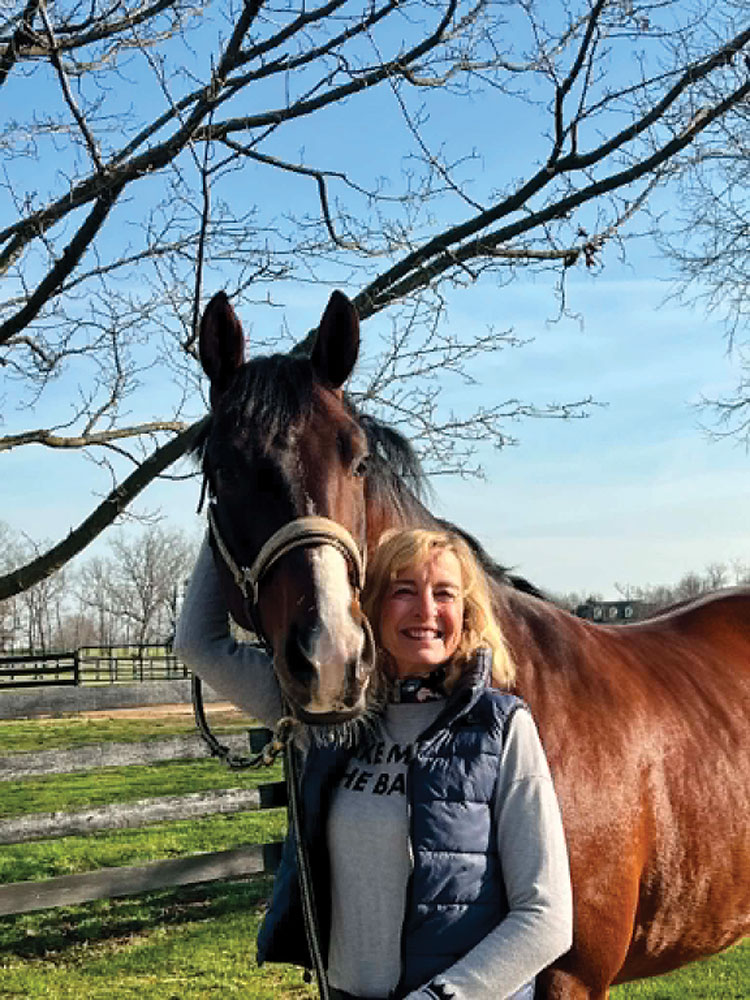 Charlotte Jorst with Nintendo Switch
For Reno resident Charlotte Jorst, cloning isn’t about the gamble of chasing championships. It’s about safety, familiarity, and the chance to ride a once-in-a-lifetime feeling all over again.
Charlotte Jorst has already proven herself a force of nature, demonstrating how a woman in her third, fourth or fifth decade can start riding, competing and become one of the leading adult amateurs of her day and discipline.
She went from lessons in her thirties — okay, a year-and-a-half of no stirrups with Guenter Seidel is a heckuva foundation — to igniting Grand Prix dressage arenas in her fifties and beyond. Along the way came the 2021 CDI3* Grand Prix and Grand Prix Freestyle wins during Week 12 of the Global Dressage Festival, 2019 FEI Dressage Nations Cup team gold, the 2018 USEF Grand Prix Dressage National Championship, and 2015 CDIO5* Rotterdam team bronze in her first Nations Cup appearance. This, however, is not your average horse tale about mid-life mastery of timeless riding traditions. It’s more like mastering time itself. Because Charlotte has become one of the best-known, unabashed advocates for the ultimate in building consistency in your horse: cloning.
It’s Not What You Think
“Oh everybody says you did this because you want more championships. No, it’s not,” says the Reno, Nevada-via-Denmark horsewoman and entrepreneur, who has translated an innate find-the-need-and-fill-it pragmatism into two successful retail companies from scratch. Her Kastel Denmark protective clothing line was born after a skin cancer diagnosis, and Skagen Denmark created lean, clean watches to nip at the wrists of Rolex. Now the former watch designer is cloning horses. Not to stop time, but to finely tune its gears.
“People want to project their motives on you,” Charlotte says of the occasional backlash to her decision. “But for me, it [cloning] is a safety and comfort thing.
 Super Nintendo
“I already know their every idiosyncrasy. For instance, they [three clones of KWPN stallion Kastel’s Nintendo] have the same hooves that are weakest on the right side. I know when and where to look for quarter cracks and how to shoe for them because Nintendo got them, too. “Cloning wasn’t about winning. It has been a much simpler motive. It’s about my familiarity with how to care for them.”
Charlotte, like her horse, wasn’t getting any younger when she began considering cloning. “I was facing Nintendo getting older, and I was 61. I think that was where I was mentally.” And let’s face it, 61-year-old bodies don’t bounce back the way they used to. Learning a new horse — and conversely, their learning her — can be fraught with “oops moments” of parting company that could lead to serious or permanent injury. Working with horses whose “feel” she already understood and knew how to ride would be arguably safer, especially after candidly admitting her own reflexes weren’t what they once were. Sure, she rode stallions — Kastel’s Nintendo and Zhaplin Langholt — but still. On the ground, a clone would offer horse care routines and decisions Charlotte was comfortable managing, lending an edge to building out her budget and calendar. From the saddle, knowing how to ride a clone’s identical conformation and way of going might build a better performance partnership sooner.
All boxes checked, right? Not quite.
It’s So Much More
There has been one slightly uncanny aspect to cloning she wasn’t expecting.
“It’s been a spiritual experience,” she says of an elusive quality hard to describe otherwise. “It’s crazy, I know. But there’s something else to them. They’re… older. Not just more mature in physique but older souls.” Nintendo was always good on crossties, but she didn’t expect his clones to accept them at first blush. “They instantly took to the crossties. Like they’d seen them and been on them all their lives.
“For sure there’s some ‘phantom memory’ they carry inside.”
Phantom, or cellular, memory is an unproven theory that memories can be stored in tissues and cells outside the brain. If clones make such uncanny connections in the barn, can they settle as comfortably into their creator/rider, too?
 Led Zhaplin at 3 years old
“For sure, they connect with you more,” Charlotte says, and the better the connection, the faster the progress seems. “I am riding a four-year-old who went from Intro to First Level in just six months. It’s as if he already knows what I am going to ask.”
Cloning might also be “for the people” more than current import/export models.
“I think cloning gives people who have otherwise given up on shopping for six- or seven-year-olds in Europe new options in riding and ownership.”
Nor do you have to enter uncharted waters alone. Charlotte worked with ViaGen Pets and Equine, the world leader in equine cloning in North America, based in Whitesboro, Texas, to create a genetically identical copy of each of her stallions using advanced cell and embryo technologies. Fun fact: The first research institution in America to clone a horse was Texas A&M University in 2005.
The resulting foals shared the same DNA as the original horses, preserving those genetics for the future.
At roughly $85,000 for your first clone, Charlotte sees it as more cost-efficient than embryo transplant: “Guaranteed. They keep trying until it catches.”
A With Six You Get Eggroll bonus is that your first clone is $85,000, but engineer a couple more while you’re there and the price, she says, drops significantly — under $15,000 per clone. Even if you don’t enjoy mathing your math, spending $125,000 for three horses you’re going to feel pretty confident about sounds better than spending the same, or more, importing one unknown equine entity, plus tariffs, quarantine and all the rest.
“You can probably pay half that price [for cloning] in Argentina but then you have to ship the horses, so there’s another thirty thousand or so in expenses.”
In Argentina, equine cloning is considered a “mature industry” that keeps the top tiers of polo energized with high-goal polo pony clones.
Dressage is using clones, she posits, but riders are not always quick to talk about it. In 2025, three years after the arrival of Charlotte’s Nintendo Switch and Nintendo 64, ViaGen cloned the Westphalian gelding and two-time Olympic dressage mount Bohemian, campaigned by Endel Ots for Zen Elite.
“There have probably been clones that have really ‘made it’ but we don’t know it, because they don’t talk about it. I’m pretty sure,” she says, “I’ve seen clones at Devon.”
Pour Your Own Fountain of Youth
Another benefit for the older dressage rider who, like her, fell in love with the ride they once shared on a now-aging partner is how clones rise anew like Brigadoon, bringing that once-familiar pep to their step with them.
“I’m showing five-year-olds again! Can you believe it? What a great thing to do,” she says, beaming a grin and dreaming a dream of 2028 Olympic dressage squads. You can’t live in Reno without developing a taste for taking a gamble. “Since the day I came to the United States, I’ve been a risk taker. I wouldn’t have it any other way.”
Nor would the tens of thousands of women, dressage riders and horse lovers on TikTok, Instagram and Facebook (@charlottejorst) who follow her and her horses, ad infinitum.
When you’re doing it right, don’t change a thing.