
Training With: David De Wispelaere
A Compassionate Introduction to First Saddle, First Ride
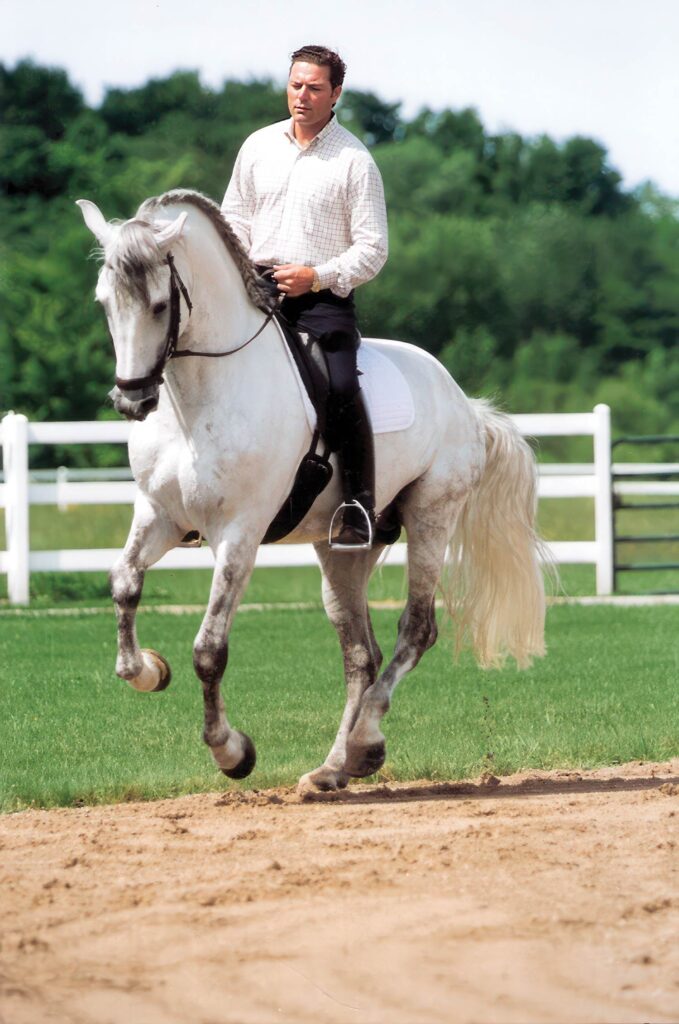
For My Horses Have Something to Say author and 1990 U.S. Grand Prix National Freestyle Dressage champion, David De Wispelaere, training has never been synonymous with breaking.
Ten years ago, the Happy Hoofers 4-H and Mendon (NY)Pony Club alum returned to the United States, after riding and training since the 1980s predominantly in Europe, where he gained a refreshingly compassionate and equitable approach to training horses: “I ask horses to dance with me. Not enter a boxing ring.”
David walks that talk, sharing the kind of enviably sympatico relationship with horses usually reserved for Walter Farley or Marguerite Henry novels. Especially with 2005 German Rheinlander stallion, Florentin, raised and trained by David since a colt, “He was born in a castle in Germany so he does think that he’s a prince.”
If your goal — whatever your discipline — is so much synchronicity with your four-legged partner that you seem to breathe as one, look no further than the ground-to-saddle relationship between David and Florentin chronicled on Instagram, @dwdewispelaere. Tacked and willing, the red stallion saunters hands-free from barn over to mounting block (after pausing to sniff the flowers). Once David is in the saddle, a cookie awaits, and it’s off for a GoPro ride from between happy horse ears.
These are some of the rewards to compassionate horsemanship and, if you’re lucky enough to have a young horse, you have what he calls “a blank canvas.” Like Beato and Heroico, two talented but different young horses whose introductions to the mounting block and that First Ride have been shared on IG.
Getting a horse to say yes to the saddle and rider starts with a few good steps and a whole lot of “good boys.”
The Cast
“For me, working with young horses is about avoiding negative experiences.” So who are the young horses in David’s good hands?
Heroico is a four year-old Trakehner (Herzensdieb “Heart Stealer”) colt with Thoroughbred breeding on his dam’s side, and stands 16.3 hands. He says the colt has “a lot of blood” but understands voice commands and was finding his trot after only a couple of trips under saddle. “Heroico was a little distrustful on the ground but after being a little over reactive I’m pleasantly surprised at how comfortable he is under saddle. We’re almost in sync with our legs.”
Beato MG III is a 16.2 hand (“and growing like a weed”) 2021 PRE Andalusian (Andaluz Mango II) stallion bred by Yeguada Marin Garćia who was so sensitive at first that David learned to whisper vocal commands to get smoother, less “surprised” transitions.
“If someone throws a ball you don’t expect, you ‘brace’ against it. But the tickle of a feather can ‘wake up’ nerve endings,” he said, likening the young horse receiving a voice command to catching a ball. “A shout gets one reaction. A soothing tone gets quite another.”
It’s a fine place to start an introduction.
Big Steps Not Taken Lightly
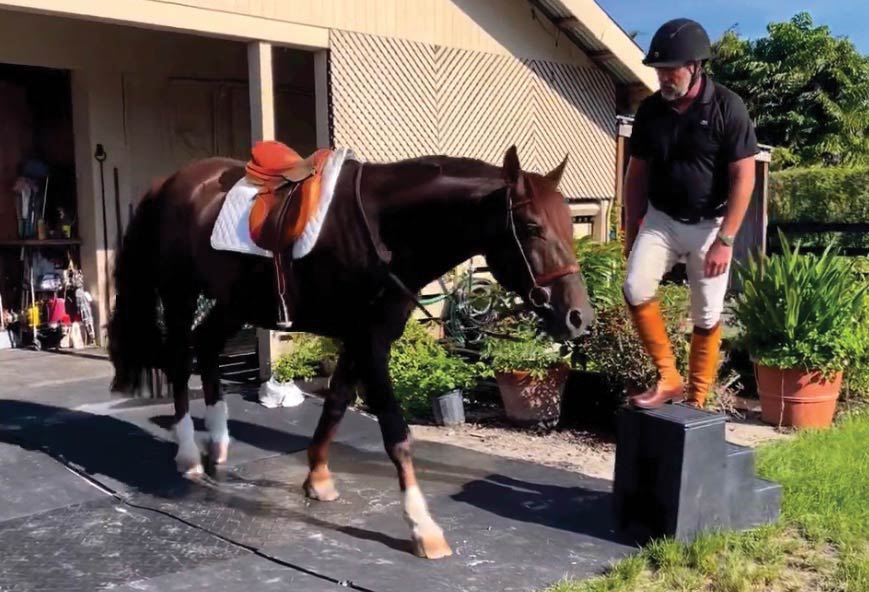
The first step to under saddle begins before a saddle and at the mounting block.
Step up and step down a few times. Shuffle your feet on each of the steps. Jump around a little. Repeat this with the block on both the near and off sides.
“Heroico never cared, but Beato? The first time I dismounted he was shocked. Beato was good with me on the ground in the round pen. But when I stepped on the mounting block his eyes popped! I don’t think he expected me to be tall enough to look him in the eye. So first, we had to work on building his confidence with two- and then four-step mounting blocks.”
- The Saddle: Once a mounting block is a non-issue, try a saddle with no stirrups, girthed lightly but securely while your horse is haltered to a long lead. And don’t use your best saddle, obviously. Use that spare in the back whose tree and flocking can take a rollover.
This step takes time. Introducing the girthed saddle is a multi-step process. Start without stirrups attached. Graduate to stirrups with the billets run up on each side. Then longe line work with the stirrups dropped to accustom each side to (eventually) a rider’s legs. - Weight and the Saddle: No, don’t throw that right leg over yet. After accepting the saddle and girth, and your standing on the block, just lean on the saddle. Keep your weight over the center and your legs on the block so, in case your horse is surprised and moves sideways, you can jump clear.
- Weight and the Stirrups: Nope, no legs yet. Drop each stirrup, on the near and then off side, give the billet a good tug from the ground and go through the motions of sliding your foot in and out. In 1998 the German Equestrian Federation found correlation between equine spinal torque and mounting with/without a block, so don’t pull the stirrup/saddle too hard toward you.
- Your Right Leg: You’ve tugged stirrups, snapped billets, played with girths, and introduced your weight and presence in all sorts of ways around the mount block. So while your horse is now convinced their favorite cookies source is quite daft, quietly slide that right leg over like an afterthought and lower your weight into the saddle.
Praise
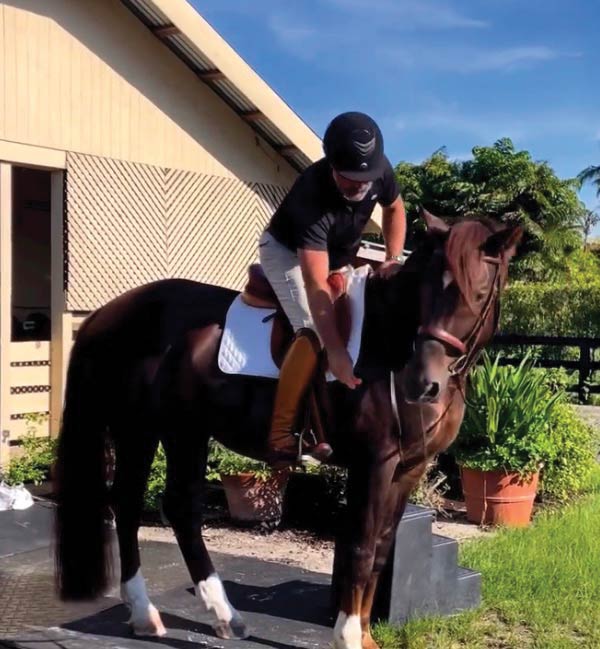
“Offer tons of ‘good boys’ and say a little prayer,” the pragmatic veteran of clinics throughout Belgium, Czech Republic, Denmark, Germany, Netherlands, Norway and Switzerland suggests.
He’s only half-joking about the “good boys.” Talking to young horses is important. “It’s not the words. It’s the tone. It goes in the ears and through the body.”
Voice works to a trainer’s advantage when introducing a canter. “It’s natural to pick up a canter on a hill. Cue your ask to its rhythm, ‘can-ter,’ ‘can-ter.’ Have an ‘up’ tone and a ‘down’ tone to use when asking for transitions. Every horse understands this.”
The working title for his 2021 autobiography, My Horses Have Something To Say, was ‘Conversations with My Horse’ for a reason: “Working with a horse should be a two-way conversation and it’s up to us to make the conversation interesting. If you speak in a monotone no one is going to listen. Imagine speaking to your horse as if you are reading a story to a child.
“Intonation commands attention.”
Rewards
Rewards can mean a soft touch or voice, or organic baby carrots and horse cookies.
“When Heroico was introduced to a bit, he couldn’t figure out how to take carrots but did cookies! So you must discern the treat that will work for the horse. Florentin lives for food. He’s a stallion with a pony brain. I wish I’d introduced carrots sooner in his training it would have made negotiating with a stallion easier!
David uses lunging when first introducing voice commands but values more intimate, one-on-one groundwork. “I don’t need to ‘tire a horse out’ or chase it in a circle. I love walking next to a horse and using my voice to work on the same transitions as under saddle, like a ‘walk on’ or a long exhale to ask for a whoa.”
Communication begins with little steps. Tacking up at the barn. Entering the pen after opening and closing the gate. Earning cookies before reins are touched. Treats become a “built-in safety feature” to encourage young horses to associate mounting blocks and training rings with positive experiences.
Because the best rewards we can offer are patience, understanding and compassion.
“Horses,” David reminds us, “just want to give their best, and to be trained calmly and with understanding.”
See more videos of David starting young and green horses on IG and his YouTube channel, @DavidDewispelaere.