
Of Timber & Trees: The Maryland Hunt Cup as Family Business
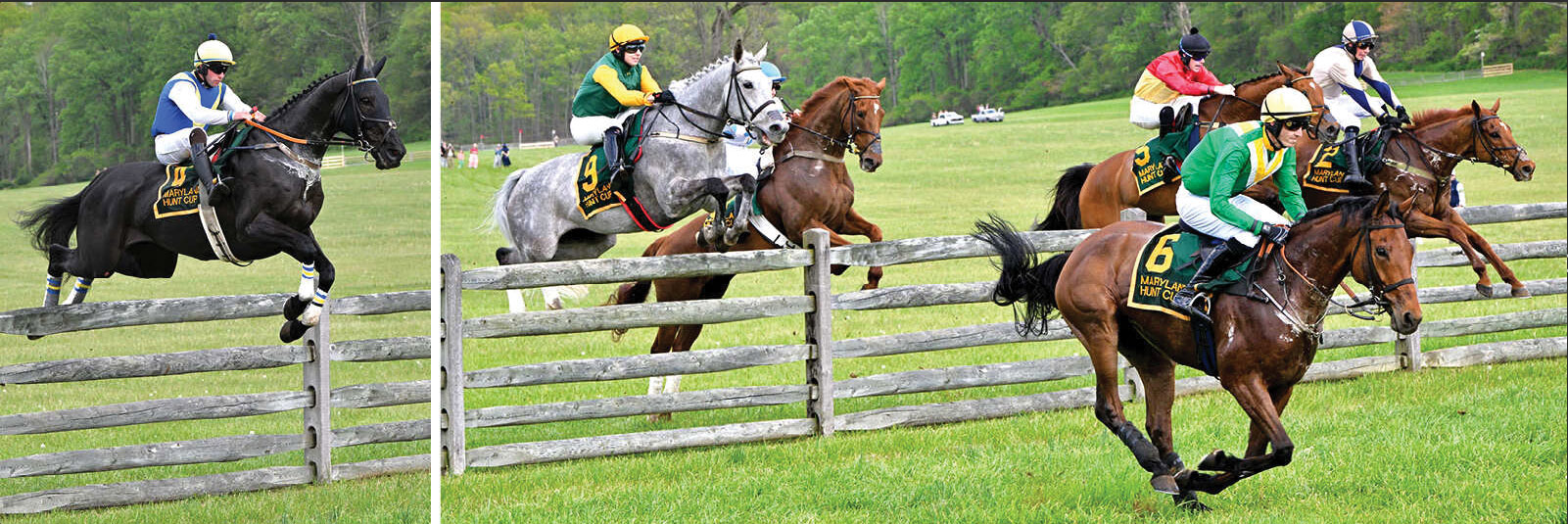
For more than a century, the Maryland Hunt Cup has been shaped by families—riders, trainers, breeders and foxhunters whose names return again and again to the timber course.
“The Hunt Cup is somewhat a family affair.”
– Margaret Worrall
To Lord Tennyson, spring lightly turns a young man’s fancy to thoughts of love. In Maryland horse country, spring turns thoughts elsewhere—toward timber.
Specifically toward the heart-pounding, palm-sweating four-mile test known as the Maryland Hunt Cup, where horses and riders gallop across open countryside and meet twenty-two solid timber fences built of oak rails that neither bend nor forgive. Across rolling pastures and hedgerowed hunt country, riders come at those fences at racing speed, knowing that the tallest obstacle on the course—Fence Six, rising four feet ten inches high—has ended many hopeful afternoons before the finish line ever comes into view.
In many runnings, fewer than half the starters complete the course. The fences do not give. The horses must be bold, the riders precise, and both must possess the rare athleticism required to clear four miles of timber at full gallop.
In this landscape of open fields and long galloping ground, the Maryland Hunt Cup has grown into something larger than a sporting contest. It is, quite literally, a story of timber and trees—of fences built from oak rails and family trees whose branches have shaped the race for more than a century.
Traditionally held on the last Saturday in April, the Hunt Cup began in 1894, when amateur riders from the Elkridge Fox Hunting Club challenged fellow horsemen from the Green Spring Valley Hunt Club to a race over natural foxhunting country at the end of the hunting season to determine whose horses were the fittest.
The inaugural victory went to John McHenry, riding his bay hunter Johnny Miller, remembered as “short on speed but long on jump.” “The first race was so successful that,” chronicler George Brown Jr. wrote, “another was held the next year.”
And the year after that.
Save for an honorable pause during World War II, the race has endured ever since. April 2026 marks the 129th running, and from those deep roots has grown not merely a race but a living inheritance—one shaped by families whose names return again and again to the timber course.
A Dynastic Commitment
“The Hunt Cup is somewhat a family affair,” Margaret Worrall wrote in 100 Runnings of the Maryland Hunt Cup (1997), and no phrase better captures the race’s peculiar continuity. A glance through the records reveals fathers and sons, mothers and daughters, husbands and wives, siblings and cousins, all returning to the same timber course decade after decade.
Among the most visible of these lineages is the family of Charles C. “Cuppy” Fenwick, longtime Hunt Cup director. His son, Charles C. “Charlie” Fenwick Jr., won the race five times (1977–79, 1983, 1987), and grandson Charles C. Fenwick III added another victory in 2008. In the modern era, Joe Davies won three times (1998, 2000, 2005), and his son Teddy Davies set a course record winning at age eighteen in 2022. Teddy’s mother, Blythe (née Miller) Davies, had already won the race herself in 2011.
Where timber racing grows, family branches tend to follow.
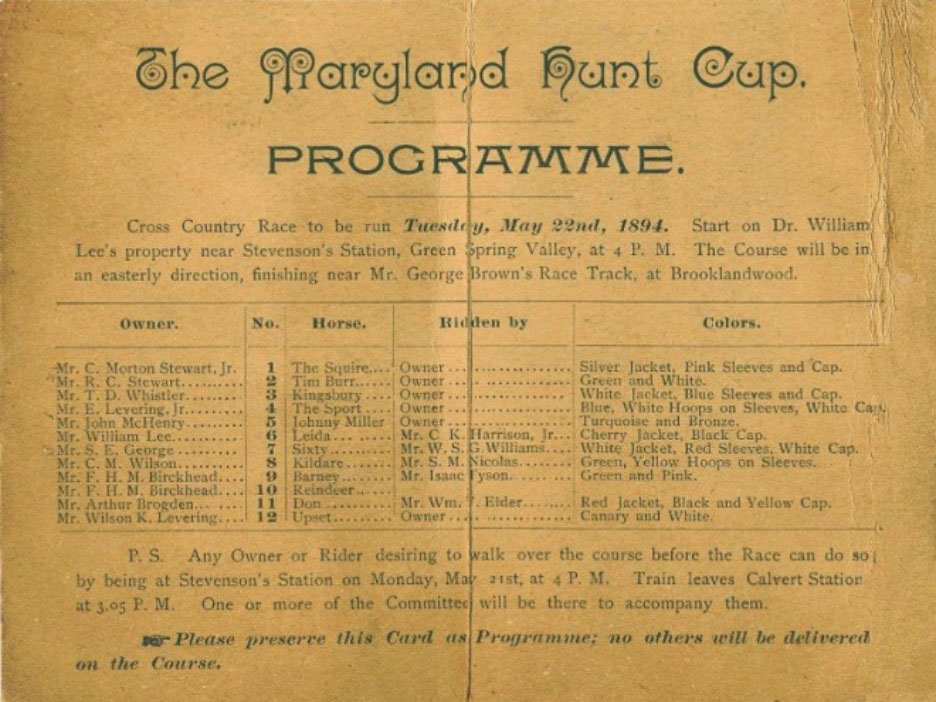 With permission from the Alex Brown archives, all rights reserved.
Bonsal
“I was born on a horse,” Frank A. Bonsal Jr. once said—a line that might as well serve as the family motto.
His father, Frank Adair “Downey” Bonsal, won the Hunt Cup twice, in 1927 and 1928, aboard Bon Master, owned by C.L.A. Heiser. Nearly three decades later the family repeated itself when Frank Jr. won the 1956 race on Lancrel, owned by Hugh J. O’Donovan.
“Downey went on to spend his life in farm management and racehorse training,” Worrall noted, “but son Frank has become an investment broker and remains in the horse game for the sport of the thing.”
The Bonsal story also catches the race at a cultural turning point. In 1972, The Maryland Horse asked Bonsal Jr. what he thought of Kathy Kusner, the Olympic show jumper who had ridden Whackerjack to sixth place in the 1971 Hunt Cup after winning a landmark 1968 lawsuit that forced the Maryland Racing Commission to issue her a jockey’s license.
“We wouldn’t want some nice young woman to go out on a bad horse and get beaten up for life,” he said.
History, as it often does, moved faster than opinion. By 1979, the Hunt Cup had formally opened itself to women. That year Toinette (née Jackson) Neilson rode in the race. The following spring, Joy Slater won it.
Bosley
“Growing up I thought the Hunt Cup was the greatest race in the world,” said Betty (née Bosley) Bird in 1954 after Marchized won. More than two decades later she was still saying it. “It still is.”
The Bosleys had pursued the Cup for years. Patriarch John Bosley Jr. rode in thirteen Hunt Cups between 1911 and 1926, coming closest in 1919, when Black Amber finished second to Chuckatuck, ridden by Jervis Spencer Jr.
Betty herself was a gifted horsewoman, a show rider with a talent for teaching horses tricks. Her gray Count Stefan had once been considered dangerously vicious and was purchased by her father for $85.
“By the time the war was ending he was a different creature,” she recalled. Her father even appealed to the Hunt Cup committee to let her ride him. “Not that Daddy approved of girls riding races but there weren’t any other riders available that he wanted.”
The committee said no. The mount went instead to her brother, John “Jackie” Bosley III, who finished behind the mighty Winton. Betty later laughed at the irony. “I was very disappointed that I didn’t ride, but when women were finally allowed in the race, I didn’t approve at first either!”
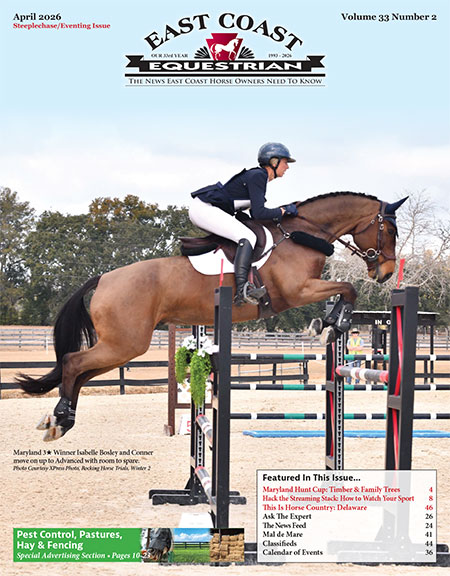
The Bosley line continues into the present through Advanced three-day event rider Isabelle Bosley, this month’s cover subject—another branch of the same Maryland hunt-country tree. Isabelle grew up foxhunting, galloping racehorses, and riding timber, which is to say she grew up in the same soil that has long produced Hunt Cup riders, steeplechasers, and eventers alike.
Davies
“Winning the Hunt Cup is something you dream about your whole life,” Teddy Davies said after his ride in 2022, when at just 18 years old he captured the Cup and set a new course record.
Few modern families illustrate the Hunt Cup’s living family tree more clearly than the Davies–Miller household, where steeplechasing runs through multiple generations. Teddy’s father, Joe Davies, won the Maryland Hunt Cup three times as a rider—1998 on Florida Law, 2000 on Swayo, and 2005 on Private Attack. He later added another chapter as a trainer, preparing winners including Senior Senator, who captured the race three times (2016, 2018, 2019), as well as Teddy’s 2022 champion Vintage Vinnie. From the family’s Dunmore Farm in Monkton, at the center of Elkridge-Harford hunt country, the Davies stable has bred, produced, and campaigned many of the timber horses that define the modern Maryland circuit.
The other side of Teddy’s pedigree carries an equally deep timber lineage. His mother, Blythe (Miller) Davies, won the 2011 Maryland Hunt Cup and earlier led the National Steeplechase Association rider standings in 1994 and 1995. Her father, Bruce Miller, was one of the sport’s most respected horsemen, a leading trainer whose horses included Make Me A Champ, winner of the 2005 Hunt Cup. Blythe herself rode the Hall-of-Fame steeplechaser Lonesome Glory during his championship career.
The Miller family’s Pennsylvania timber roots have long intertwined with Maryland’s hunt-country circuit—and with other Hunt Cup dynasties, including the Fenwicks—another example of the Pennsylvania–Maryland alliances that have long knit the sport’s community together.
Fenwick
“The race has always been bigger than life,” Charlie Fenwick Jr. told The Maryland Horse in 1990. “Steeplechasing has given us a tremendous amount of excitement and satisfaction, and it is our hope that we can return some of that to the sport through our children.”
If any family has come to embody the Hunt Cup itself, it may be the Fenwicks.
Charlie’s father, Cuppy Fenwick, served as Hunt Cup secretary for thirty years. Charlie’s mother, Ann (née Stewart) Fenwick, extended the family’s roots even deeper. She descended from Redmond Stewart Sr., who placed in the inaugural Hunt Cup, and from Redmond Conyngham Stewart Jr., who won the race in 1904 aboard Landslide. She was also the great-granddaughter of G. Bernard Fenwick, who helped design the 1922 course. Ann herself became a three-time Hunt Cup-winning trainer, including with Ivory Poacher in 1993.
Charlie Fenwick’s great equine partner was Ben Nevis. Early attempts to hunt the horse convinced Charlie’s brother Bruce that the enterprise might be doomed.
“It was a rodeo,” Bruce said. “He lunged and bolted through the woods. We didn’t get anywhere.”
Charlie persisted anyway.
“He always pulled like hell,” Fenwick later said. “After fifteen minutes my arms would be screaming.”
Ben Nevis broke his maiden in 1976 and won eight races the next year before taking the 1977 Hunt Cup. “Ben Nevis erupted at the drop of the flag,” wrote Peter Winants. Fenwick stood straight up in his irons trying to steady him, but moderation was never Ben Nevis’s gift. Once his rider let him run, the pair flew the fences and led throughout.
The wider Fenwick branch includes Charlie’s uncle H. Robertson Fenwick—Master of Foxhounds of the Green Spring Valley Hounds, rider of the dual champions Fluctuate (1959–60), trainer of the 1956 winner Lancrel, and trainer of Jay Trump, the first American-owned, bred, and ridden horse to win the Grand National at Aintree in 1965.
In Maryland timber racing, strong roots spread quietly. Sometimes through bloodlines. Sometimes through horses. Often through both.
Fisher
“Blockade wanted to be ahead of the master, hounds and fox—and liked to kick hounds,” wrote historian John E. Rossell Jr. “So what could be done with a big, strong chestnut that was a three-time dropout?”
Janon Fisher Jr. answered that question in style.
In 1938, he paired the unruly son of Man o’ War with jockey J. Fred Colwill, and the result was an 8:44 course-record victory. The next year Fisher gave Colwill a simple instruction: “Stay in front. Don’t let any horse in front of you.”
Blockade obliged. In 1940, he completed the Hunt Cup’s first three-peat.
Fisher’s influence did not stop with one horse. A breeder as well as a trainer, he later produced Mountain Dew, another timber legend. “He was all Fisher—born, bred, owned, trained and ridden by the family,” Winants wrote. The elegant gelding started eight Hunt Cups, winning three, finishing second three times, and third once. In 1968, one fence from home, he bowed a tendon and retired to become a favored Green Spring foxhunter.
“Janon Fisher was a Master of Masters,” Winants wrote. “He knew hounds, horses, country, and people like a book.”
Hannum
“From the time the race opened to out-of-staters in 1909,” noted John E. Rossell Jr. in The Maryland Hunt Cup, Past and Present, “Pennsylvania horses have won no less than 24 races.”
Few families made a more determined contribution to that record than the Hannums, whose branch of the Hunt Cup tree is rooted as deeply in foxhunting as in racing.
Nancy Penn-Smith Hannum, daughter of R. Penn-Smith Jr., who served from 1921 to 1927 as Joint Master of Virginia’s Orange County Hounds, later became the legendary Master of Mr. Stewart’s Cheshire Foxhounds in Pennsylvania. She married John B. Hannum III, son of John B. Hannum Jr., who hunted the Maryland–Pennsylvania border country around Rising Sun.
John B. rode in four Hunt Cups, placing in 1950 and 1951. The family’s greatest success came through their son R.P.S. “Buzz” Hannum, who won the race—most memorably aboard Morning Mac—while siblings John B. “Jock” Hannum Jr. and Carol Hannum also rode the demanding timber course. The next generation followed when Jeb Hannum rode the family-bred Our Climber in the 1988 running.
The Hannum story also branches into another corner of elite horsemanship. Carol Hannum married Olympian Bruce Davidson Sr., linking one of the Hunt Cup’s great timber families to one of America’s most accomplished eventing dynasties and producing Bruce “Buck” Davidson Jr. While best known for three-day eventing, the Davidson family has always remained rooted in hunting and timber racing; Bruce Davidson Sr. rode in the Maryland Hunt Cup in 1975 and 1983.
Their branch of the family tree also intersects with another Hunt Cup line through the Valentine family, whose horse Cancottage carried Joy Slater to the race’s first female victory in 1980—one more example of how the sport’s families seem always to meet again.
Across Maryland, Pennsylvania, and Virginia, the same hunt-country soil that grows timber riders has long produced event riders as well. Boyd Martin, Phillip Dutton, Jim Wofford, Denny Emerson, Michael Plumb, Karen O’Connor, and Jimmy Day all spent time steeplechasing—and foxhunting—across those same tri-state hills.
Moran
“Charlie [Fenwick] took a major chance that I would pull it together at this point in my life,” Anne Moran recalled.
At the time she was a 36-year-old mother of three, largely stepped away from racing, when trainer Charlie Fenwick offered her the ride on Buck Jakes. “You wait your whole life to ride one like Buck Jakes so you don’t get to choose when the chance comes,” she later told the Chicago Tribune.
During the race she felt something rare. “For me, that race was in slow motion, just as in tennis when the ball seems to get bigger.”
Buck Jakes carried her to victory in 1995 and 1997.
Her mother, Betty Moran of Brushwood Stable, had flown from Ireland to watch her daughter win that first Hunt Cup—on the fifth anniversary of Anne losing her father, also an amateur jockey.
And as one branch of the Hunt Cup tree fades, another often grows in its place.
Neilson
“The Maryland Hunt Cup is part of our lives. It’s what we grew up with,” said Sanna Neilson.
Few families embody that sentiment more fully.
The Neilson presence in timber racing reaches back to the 1950s and 1960s, when Paddy Neilson emerged as a rider on the Mid-Atlantic circuit. Over time he rode in 21 Hunt Cups, winning three—in 1968, 1974, and 1989—and later training another winner.
His wife, Toinette (née Jackson) Neilson, rode in the 1979 Hunt Cup as women first began appearing regularly in the race.
Their daughter Sanna Neilson became the first daughter of a Hunt Cup winner to win the race herself, capturing the 1991 edition on Tom Bob and again in 1993 on Ivory Poacher. As a trainer she continued the family tradition with runners including Floating Interest, The Bruce (2007), Guts for Garters (2014), and Royal Ruse (2023). Another Neilson branch includes trainer Kathy Neilson, whose horses Young Dubliner (2002) and Withoutmoreado (2023) both won the Hunt Cup.
The family’s continuing presence was captured in the winner’s circle at the 2013 Maryland Hunt Cup, where jockey Mark Beecher celebrated after riding Mr. Maxwell to victory in the four-mile classic for trainer Richard Valentine and owner Mrs. George L. Ohrstrom Jr. Raising the silver Challenge Cup beside him was Sanna Neilson, herself a two-time Hunt Cup winner and daughter of Paddy Neilson. The scene made visible what Worrall meant by “somewhat a family affair.” The Neilsons had ridden, trained, and bred Hunt Cup contenders for decades across Maryland and Pennsylvania. The Valentine name reached further back through Mrs. Miles Valentine, owner of Cancottage, while Richard Valentine, part of the modern Mid-Atlantic steeplechase world based in Virginia, represented a newer generation of professional horsemen. Beecher, rising from foxhunting and point-to-points in the early 2000s, showed how the old family forest still makes room for new growth.
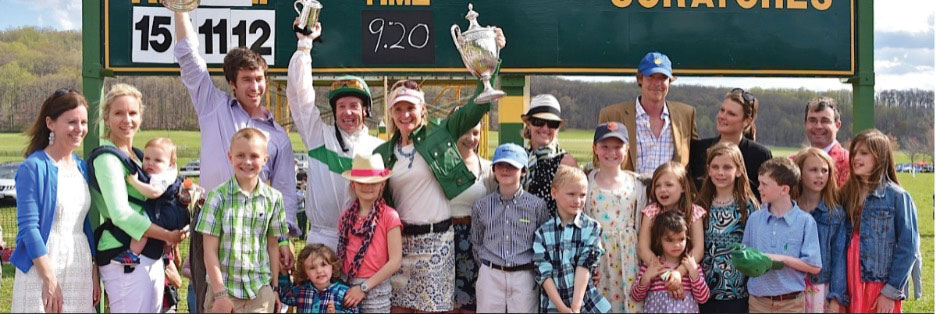 Winner’s circle, 2013 Maryland Hunt Cup. Jockey Mark Beecher celebrates after riding Mr. Maxwell to victory in the four-mile timber classic for trainer Richard Valentine and owner Mrs. George L. Ohrstrom Jr. Raising the silver Challenge Cup beside him is Sanna Neilson, herself a two-time Hunt Cup winner (1991, 1993) and daughter of three-time champion rider Paddy Neilson, who rode in 21 runnings before becoming a leading trainer. The moment captures several branches of the Hunt Cup’s extended family tree in one frame. The Neilson family has ridden, trained, and bred contenders across Maryland and Pennsylvania for decades, while the Valentine name reaches further back in the sport through Virginia horsewoman Mrs. Miles Valentine, owner of the legendary timber champion Cancottage. Richard Valentine, active on the modern Mid-Atlantic steeplechase circuit, represents a newer generation of professional horsemen, while Beecher—who emerged from the foxhunting and point-to-point world in the early 2000s—reflects the sport’s enduring amateur roots. Together the figures in this circle form a living snapshot of the intertwined Maryland, Pennsylvania, and Virginia hunt-country families whose overlapping branches continue to sustain the Maryland Hunt Cup.
Slater
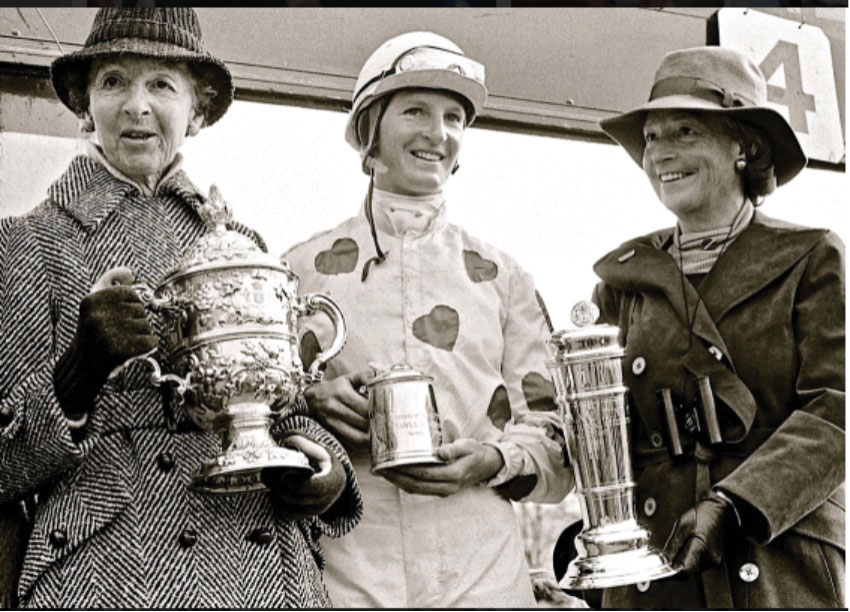 1980 Maryland Hunt Cup winner Joy Slater (center) with owner Mrs. Miles Valentine (left) and trainer Jill Fanning (right). The victory of Valentine’s Cancottage marked the first time a woman won the race and stands as a vivid example of the Hunt Cup’s family-driven tradition, where owners, trainers, and riders often come from the same intertwined hunt-country community. Courtesy of the Alex Brown archives.
“Long ago, I was a pioneer,” Joy Slater Carrier said.
In 1980, she became the first woman to win the Hunt Cup, riding Cancottage in the Valentine stable’s unmistakable pink silks with red hearts. Sportswriters dubbed her “America’s National Velvet,” but Slater always sounded more practical than romantic. “I wasn’t worried no woman had ever won,” she said. “I didn’t feel all eyes were on me. I just wanted to do the job.”
“A lot of people in that race had never jumped that high,” said the protégé of Frank Chapot. “My experience show jumping was a huge asset because I was accustomed to five-foot fences and had utter confidence in Cecil [Cancottage].” Walking the course, she said, the fences looked “a whole lot bigger” when it was finally her own year to ride. When Cancottage cleared the last timber and crossed the line, “It was like getting to heaven.”
Her breakthrough belonged to a larger family branch. Cancottage, the Irish gelding owned by Mrs. Miles Valentine and trained by Slater’s mother, Jill Fanning, made the victory the work of three women—owner, trainer, rider—something almost unimaginable a decade earlier. In 1971, Kathy Kusner had become the first woman to ride in the Hunt Cup, finishing sixth on Whackerjack after her 1968 legal victory against the Maryland Racing Commission. Women were not formally welcomed into the race until 1979, when Toinette Neilson rode. Slater’s win the next year completed the arc.
Cancottage would go on to become one of the great timber horses of the era, winning the Hunt Cup three times—in 1980, 1981, and 1983—with Slater aboard for the first two. Both Kusner and Slater had entered timber racing with substantial show-jumping mileage behind them, another reminder that the Hunt Cup’s family tree intersects constantly with the wider horse world.
Smith
“He scared me,” Tommy Smith said of the plain Thoroughbred he claimed in 1962 for $1,250. “He took off with me and I was strictly a passenger.”
The horse was Jay Trump, and few Hunt Cup stories better show how an unlikely champion can emerge from humble beginnings.
Smith himself came from foxhunting stock. His father, Crompton Smith Jr., rode early American steeplechases, including the inaugural Carolina Cup, and his grandfather, Harry Worcester Smith, was an internationally known foxhunter and sporting writer whose work helped shape American hunting culture.
Tommy first made his mark by winning the 1959 Hunt Cup on Fluctuate, owned by H. Robertson Fenwick. Soon after, recovering from a separated shoulder, he went scouting for inexpensive prospects at Charles Town and found a plain 16.2-hand Thoroughbred offered for claiming.
That horse became Jay Trump, later called by Peter Winants “the most versatile steeplechaser of the era, maybe ever.”
Preparing for the 1963 Hunt Cup, Jay Trump’s boldness was already evident. “Sometimes he stood off the fences two or three strides,” Smith said. “At the twelfth he stood back so far he landed on the top rail with his girth.” Jay Trump still set a new course record of 8:42 1/5.
By 1966, Jay Trump and Mountain Dew were both chasing their third Hunt Cup victory and the race’s Fourth Challenge Cup. Smith planned the race as Jay Trump’s final timber start.
“We challenged Mountain Dew at the sixteenth,” he said. “I knew we had too much horse for him this time.”
Smith and his former claimer galloped home eight lengths clear, retiring the trophy. Smith trained Jay Trump throughout his career and rode him to two of his three Hunt Cup victories.
Smithwick
“He always tried—gave you his best,” Mikey Smithwick said of his brother Paddy. “Some riders quit on you after a couple of fences. Not Paddy.”
The Smithwick brothers, Alfred Patrick “Paddy” and Daniel Michael “Mikey,” grew up at the Elkridge-Harford Hunt Club, where their father, an Irish immigrant, served as huntsman and stable manager. From that hunt-country foundation emerged two of the most influential figures in American steeplechasing.
Mikey’s big chance came in 1956, when he became trainer for Mrs. Ogden Phipps, whose stable soon became one of the most powerful in the sport. Within a year the operation produced 38 winners and $220,000 in earnings—nearly 30 percent of the available steeplechase purse money.
Between 1957 and 1970, Mikey was leading trainer twelve times, saw career earnings exceed $4.5 million, and developed three future Hall of Fame horses: Neji, Jay Trump, and Ben Nouvel.
Meanwhile Paddy built one of the most respected riding careers in American steeplechasing. Riding professionally from 1946 to 1996, he won nearly 400 races and five national championships, despite standing an unusually tall 5’10” for a steeplechase jockey.
“He had a great sense of pace,” Mikey recalled. “Marvelous timing into and over fences. And what hands.”
The A.P. Smithwick Memorial steeplechase, run each August at Saratoga, now honors that legacy.
Casting the Widest Shade
“Foxhunting is not a sport for a season; it is a way of life.”
— Nancy Penn-Smith Hannum
That way of life is the quiet foundation beneath the Maryland Hunt Cup and the families who have shaped it. Within the long history of the race, two lineages stand out as the architecture behind much of its story: the Fenwicks and the Penn-Smith/Hannum family.
The Fenwicks represent the most visible trunk of the sport’s family tree, touching nearly every dimension of the Hunt Cup itself. Through Charles C. “Cuppy” Fenwick, who served as secretary of the race for three decades, and his son Charlie Fenwick Jr., a five-time winning rider and six-time winning trainer, the family’s influence extended from the saddle to the stable to the governance of the race. Their lineage reaches even further through the Stewart family, linking them to the Hunt Cup’s founding generation.
If the Fenwicks have often been the race’s most visible dynasty, the Penn-Smith/Hannum family represents a more quietly woven network across the broader hunt-country world. Beginning with Nancy Penn-Smith Hannum, the legendary Master of Mr. Stewart’s Cheshire Foxhounds, the family bridged the foxhunting traditions of Virginia, Pennsylvania, and Maryland—traditions stretching from the timber courses of Maryland and Pennsylvania to the storied hunt country of Middleburg, Virginia.
That foxhunting culture has done more than produce riders and timber horses. Across this tri-state hunt country, conservation easements, land trusts, and generations of sporting stewardship have protected thousands of acres of open country—land preserved not for development, but for galloping.
It is on that living landscape, maintained by both the sung and the unsung families of the sport, that the Maryland Hunt Cup still unfolds at full stride.
The Last Saturday in April
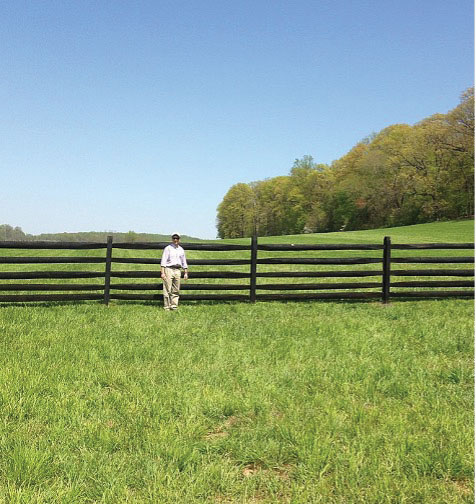 Fence Six at the Maryland Hunt Cup, 4’9” of solid oak timber. Photo by Alex Brown with public domain use permission Wikipedia
April belongs to timber racing—and to springtime pruning—so it is impossible to trace every branch of the Maryland Hunt Cup’s family trees here.
But year after year spectators gather with picnic baskets and field glasses to watch horsemen and women test themselves against four miles of Maryland countryside and twenty-two unforgiving timber fences.
And as long as the race endures, the Hunt Cup’s family trees will continue to grow.
Editor’s Note: The Maryland Hunt Cup’s story extends far beyond the families highlighted in this article. Generations of riders, trainers, breeders, and foxhunters have shaped the race across Maryland, Pennsylvania, and Virginia hunt country. Among the many families whose names recur in the Hunt Cup archives are the Beards, Browns, Clothiers, Colwills, Crawfords, Georges, Janneys, Kingsleys, McHenrys [yes, those McHenrys], McKnights, Meisters, Naylors, O’Donovans, Ohrstroms, Spencers, Stephensons, Stewarts, Streetts, Strawbridges, and Whistlers. Some remain active in the sport today, while others belong to earlier chapters of the race’s long history. We apologize to the many whose stories could not be included here—there is simply not enough room to name every branch of the remarkable family tree that defines the Maryland Hunt Cup.