


Training With Lendon Gray – Getting Deep Into Your Corners
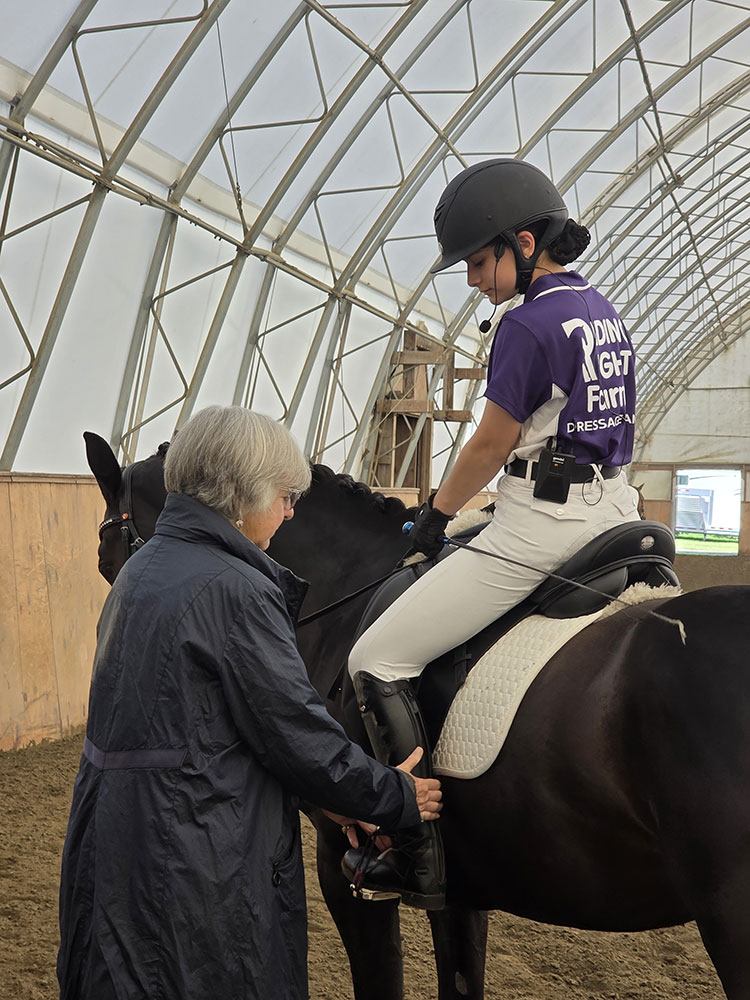 Gray coaches young rider. Photo courtesy of L.A. Berry.
From a folding chair in the corner of the arena, two-time U.S. Olympic Dressage veteran Lendon Gray patiently challenged her young D4K clinic riders: “Try and run me over.”
The prospect of trampling their mentor blanched the blush from the cheeks of some already nervously forgetting to breathe while trotting the long side of the indoor arena at Riding Right Farm in upstate New York.
She repeated, “Run. Me. Over.”
It was a light-hearted command, intended to encourage riders to deepen their corners, but no one seemed to have gotten the memo that most horses will go to any lengths not to step on icky humans.
Instead, rider after rider succumbed to turning away from her corner, with strides to spare. Running anyone over this summer afternoon wasn’t likely to happen.
But with practice and encouragement, better-ridden corners might.
The Long & Short of It
Competitively speaking, Lendon calls corners our “best friends” when we want to set a horse up for what’s next.
“Is there some ‘whoa’ or ‘go? Will they bend off your leg? Is this working? If you’re not feeling on track at C you won’t at M either.”
Her observation echoes the sentiments of another USDF Hall of Fame contemporary, three-time Olympic Dressage chef d’equipe and USEF ‘S’ judge, Jessica Ransehousen who said, “In the Dressage ring, you must look at the corners as your friend!”
In front of a judge’s box, well-ridden corners set the stage for better movements, a better-balanced horse, and a more accurate and polished ride. Judges look for corners ridden not as sharp turns or loops, but smoothly cadenced arcs, whose degree of bend and flexibility will progress as a horse moves through the levels.
“From the moment you enter the ring at A, judges take every stride into consideration, including combining corner scores with movements before, after or with a transition,” advises another ‘S’ judge, Amy McElroy, whose riding career began at Rice Farms on Long Island.
Looking at tests for Introductory and Training Levels, she says every transition (with the exception of center line) comes through a corner, so show a judge how you direct your horse’s line of travel rather than letting the rail do it for you. “Your short sides are taken into consideration the same as circles in scoring. They will be linked to a movement before, a movement after, or a movement within. Short sides are not rest breaks. Similar to corners, they are where you regroup, encourage and balance your horse as you prepare for what’s to come.”
Corners are equestrian equal opportunity at its best because every arena and every ride – from Training Level to Grand Prix — always has four of them.
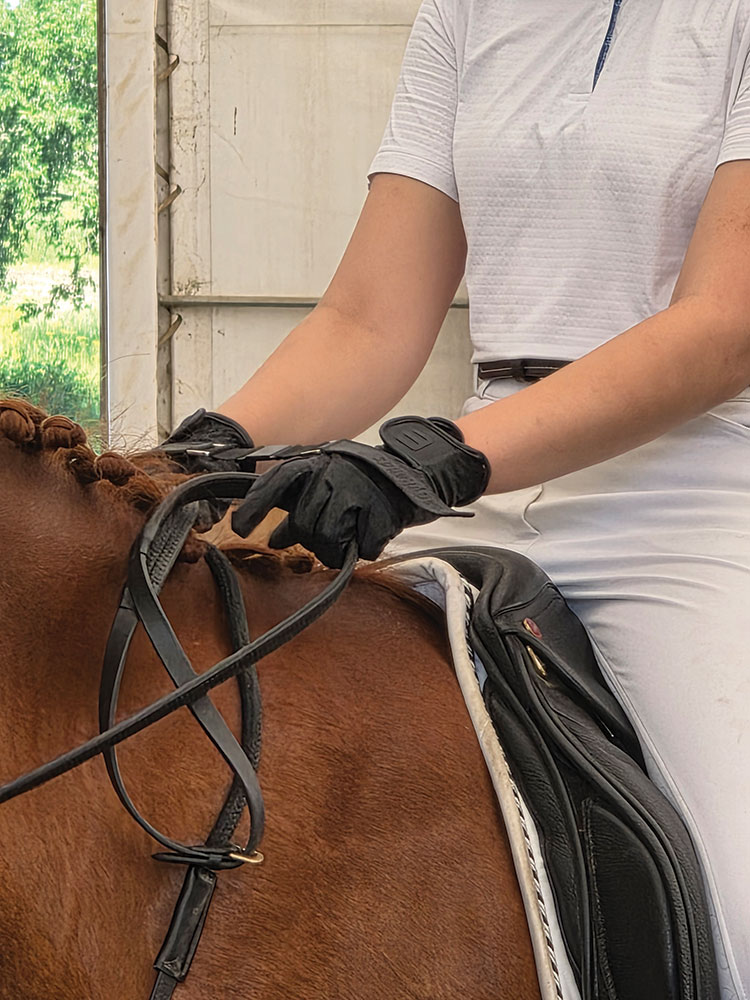 Hands are the final tool. Photo courtesy of L.A. Berry.
Casual Corners
But what if you don’t care about showing dressage with your horse? Is riding every corner well, every time, all that important?
Yes, says Lendon. To start, you are maintaining a consistency of message with your horse as they learn to anticipate and depend on your cues for turning through the corner and not just following the fence line. Riding corners — and riding them well – is a necessary exercise in discipline: “It’s got to be every corner, every ride.”
Look at corners as exercises in developing balance, bend and engagement. Even if you only dance at home when no one is looking.
The turn through the corner is among the first exercises to develop obedience to the unilateral aids, as Colonel Bengt Ljungquist observed in his Practical Dressage Manual.
“Though variations of style do occur, the main principles of dressage are eternal. Most horses will push in (cut the corner). This is prevented by a leading outside rein and squeezing inside leg, if necessary, supported by the inside rein.”
Inside leg to outside rein, you say? Yeah. That.
Turns through corners are done mainly by the inside leg in coordination with the inside rein: inside leg at the girth, outside leg behind the girth to keep haunches from swinging out, outside rein controlling the bend. The rider should shift their weight slightly to their inside seat and heel, while their outside shoulder moves slightly ahead, following their horse’s outside shoulder.Coming out of the corner, straighten the horse using the outside rein and push forward into the “new” direction.
“Riding a corner,” Lendon explains, “is like riding a quarter of a volte or small (6-to 10-meter) circle, with the horse flexed to the inside. The rider is using aids and bend similar to riding a circle. The bend part, the quarter-volte, is a collecting exercise you get four chances at in every ring you ride.”
“The importance of your inside leg is to ask the horse to step under and bend in their rib cage, while your outside leg keeps the haunches from falling out. Your horse should come out of a corner rebalanced.”
Halt, Go and Replay
One of the simple but corner-friendly exercises the founder of Dressage 4 Kids (D4K) likes to employ is also a lesson in teaching a horse to wait for you.
This ‘halt-go’ exercise can be performed at the walk or trot, involves no special equipment, and builds both balance and better communication.
Start by approaching your corner at a walk. “Then two or three strides before, ask for an almost-whoa. Then walk on, straight into your corner, turn and almost-whoa again, before asking them to move forward.”
With practice, you will feel the almost-whoa incrementally shift to a half-halt. With every trip around the ring are four chances to repeat the exercise: Halt. Forward. Bend/turn. Halt. Forward.
“Teach the horse to wait for you,” she says, admitting to being a “little bit of a purist” when it comes to the half-halt. “It’s a rebalancing exercise. Sit up straight. Put your leg on, let your horse come back, and let them learn to anticipate your aids because you’ve been consistent.”
Out of the saddle, this forward-thinking coach says the opportunities have never been greater to listen and learn from – or hit the replay button to – the performances of more experienced riders from anywhere around the world.
“We are so lucky today, to get to hit a replay button on rides we want to watch again and again,” she says. It’s a long way from Seoul and the 1988 Olympics, where she wrote in her journal about her amazement “watching the training of so many athletes” and where the first seeds were planted for what would lead to D4K and “Lendon’s Youth Dressage Festival” back in the United States.
“There was so much that could be done to bring up educated athletes as riders,” she mused, back in the days before the Internet or streaming services.
Among the legends of yesterday that today’s riders can replay is one of Lendon’s own great influences: Jack Le Goff, who coached U.S. Three-Day Eventing in its “Golden Age” (1970-1984). Fun fact about Lendon, prior to qualifying for two Olympic dressage teams, she was a Preliminary-level national champion in three-day eventing, having spent two years training under Jack’s guidance. (Hint: Learn more about Jack Le Goff in this 1982 interview, now a HorseTV Global video on YouTube, Jack Le Goff Eventing: Molding Champions.)
Watch riders you admire. More than once – and get granular about it, she says.
“Watch the same rider a couple of times, but watch them for different reasons,” she says. For example, “What do they do in their corners? Or, just focus on one part of their ride. How do they use their legs? How do they use their hands or handle the bit?”
Speaking of hands… there’s one more tool in her clinic arsenal that helps keep hands steadier and consequently, helps riders communicate more clearly to their horse.
It started with a pair of technical riding gloves with a quick-release safety band known as SteadyHands, by a company in Australia called Equisk.
“I use them a lot,” she says, to improve hand position and rein contact. But some found them claustrophobic. “One adult amateur absolutely panicked. Others love them. Everybody moans and groans at first when they go on, but they really help make a rider aware of what they’re doing. I’ve seen riders see-sawing high and low and completely unaware of doing it.”
Since last summer, she’s discovered an evolution to the gloves. A stream-lined design by TactEQ is a glove-free alignment aid designed to help riders create more elastic contact, steadier rein connection, and clearer communication through hands that guide, not pull.
“And I can just stuff these in my pocket,” she says, en route to her next clinic.
Where she’ll be asking more riders to run her down in the corners.
Image on cover courtesy of L.A. Berry.