
A Small State with an Outsized Passion About Its Horse Country
From Pimlico and Fair Hill to hunt fields, school barns, polo grounds and Eastern Shore community networks, Maryland’s equestrian life is compact, serious, and deeply rooted.
The first thing to understand about Maryland horse country is that it does not stop neatly at the state line. Maryland riders think nothing of hauling to Chester County, Upperville or the Virginia countryside for the weekend, and the Maryland Horse Show Association’s calendar reflects that reality, listing shows across Maryland, Pennsylvania and Virginia. This is a compact, border-crossing horse world.
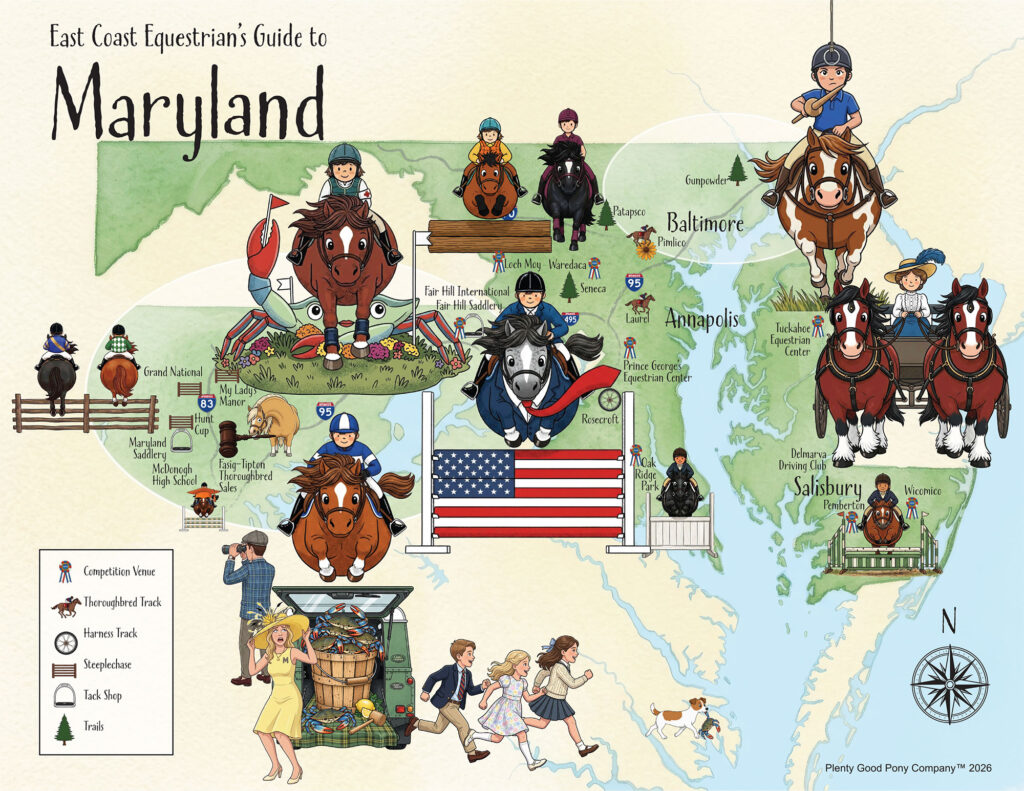
Within Maryland, the geography is more specific, divided along scattered tracts: hunt country along the Harford County line, state-owned turf at Fair Hill, a major public arena in Upper Marlboro, eventing and dressage farms in Frederick and Montgomery counties, and smaller but stubbornly active horse communities on the Eastern Shore and in Southern Maryland.
Each of those islands combine to create a powerful economy. The American Horse Council Foundation’s 2023 study estimates about 94,000 horses in Maryland and $2.9 billion in economic output. Racing alone accounts for nearly 9,000 jobs. State sources also note Maryland’s unusually high horse density, and the state supports hundreds of licensed stables, public equestrian facilities, school programs, youth organizations, therapeutic riding centers and private farms.
Maryland’s most famous horse is still the Thoroughbred, and its most famous day is still the Preakness. But racing here is not just Pimlico. Laurel Park, Timonium, Rosecroft, Ocean Downs, Fair Hill and Shawan Downs all help tell an industry story tied to jobs, land use, breeding, training, sales, aftercare and public investment. At the Maryland State Fairgrounds in Timonium, Fasig-Tipton’s two-year-olds in training sale gives the Thoroughbred trade a different kind of stage: sale-ring lights, buyers on the rail and, this year, 384 horses changing hands for about $53 million.
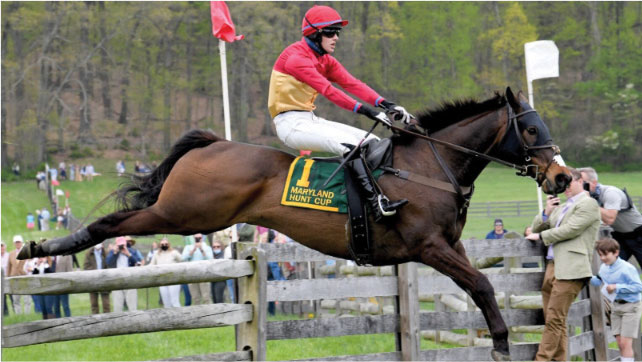
North of Baltimore, the spring timber circuit gives Maryland one of its deepest sporting identities. My Lady’s Manor in Monkton, the Grand National Steeplechase in Butler and the Maryland Hunt Cup at Glyndon sit almost on top of one another in April. The Hunt Cup, run over timber since 1894, remains one of the most demanding amateur races in America. These are not polished stadium spectacles. They are hayfields, post-and-rail fences, tailgates, old timber horses and families who know exactly where they stand along the rail.
The hunts sit behind the racing, often on the same land. The Masters of Foxhounds Association lists nine hunts in Maryland, and the names map the culture: Green Spring Valley, Elkridge-Harford, Potomac, Howard County-Iron Bridge, Goshen, Marlborough, De La Brooke and others. Green Spring Valley Hounds describes its country north of Tufton Avenue between Reisterstown Road and Interstate 83. Elkridge-Harford is based in Monkton and runs from September through March. Farther south, De La Brooke carries the tradition into Charles, St. Mary’s and Calvert counties.
Fair Hill gives Maryland its international sport-horse anchor. The state-owned land outside Elkton covers more than 5,600 acres and holds trails, turf, race barns, arenas and competition grounds. Jump racing there dates to 1934; after a six-year gap, the Fair Hill races returned as a one-day meet in 2025 and again in May under the Maryland Jockey Club. The Maryland 5 Star, first run in 2021, is paused for 2026, with a three-star and Young Event Horse championships filling the calendar while organizers work toward a five-star return in 2027. Fair Hill’s power is that public land, local riders and international ambitions all meet on the same ground.
Upper Marlboro gives Maryland another kind of public horse infrastructure. The Prince George’s Equestrian Center and Show Place Arena host the Capital Challenge Horse Show and the Washington International Horse Show, which returned to Maryland in 2022. It is not just a venue; it is proof that county-owned facilities can carry national horse sport.
The school and amateur pipeline is equally important. McDonogh School in Owings Mills keeps a riding program on campus and hosts hunter/jumper shows open to outside riders. Garrison Forest and St. Timothy’s also give Maryland unusually visible school-based equestrian programs. Goucher College and the University of Maryland add higher-education pathways, while Pony Club, 4-H, IEA teams, lesson barns and therapeutic riding centers fill in the practical middle.
That middle is where Maryland’s horse industry really lives. Loch Moy Farm in Adamstown hosts horse trials and dressage. Waredaca in Laytonsville runs horse trials and Potomac Valley Dressage Association shows. Shawan Downs in Cockeysville hosts point-to-points, horse trials and the Legacy Chase. Poolesville has the Potomac Hunt Races at Bittersweet Field. On the Eastern Shore, Layfield Sport Horses hosts hosts inviting starter trials, dressage, show jumping, and cross-country schooling. Tuckahoe Equestrian Center near Queen Anne lists jumping, dressage, driving and jousting, while Salisbury’s Wicomico Equestrian Center and Pemberton Equestrian Center help anchor Delmarva’s hunter, equitation, western and driving communities. Maryland’s horse culture is as varied in the traditions that keep local horse community connected as it is serious about all things horse: polo around Elkridge-Harford, Ladew and the Maryland Polo Club fields, as well as Poolesville, Congressional and Seneca; driving through groups such as My Lady’s Manor Driving Club and Delmarva Driving Club; and a deep hunt and Pony Club pipeline where organizations such as Elkridge-Harford, Green Spring Valley, Potomac, Marlborough and De La Brooke preserve land-based riding traditions while Pony Clubs carry horsemanship, teamwork and community into the next generation. In fact competitive jousting is Maryland’s official state sport since 1962. It is still a competitive concern, especially in the tidewater and Southern Maryland communities where horses, family, church grounds and local tournaments still overlap.