
Eighty Years Under the Harrisburg Lights – This Year Even Better
The Pennsylvania National Horse Show returns with richer prizes, top names, and expanded championships bringing the country’s best hunters, jumpers and equitation riders to an historic venue that’s still family-friendly and remarkably close to home.
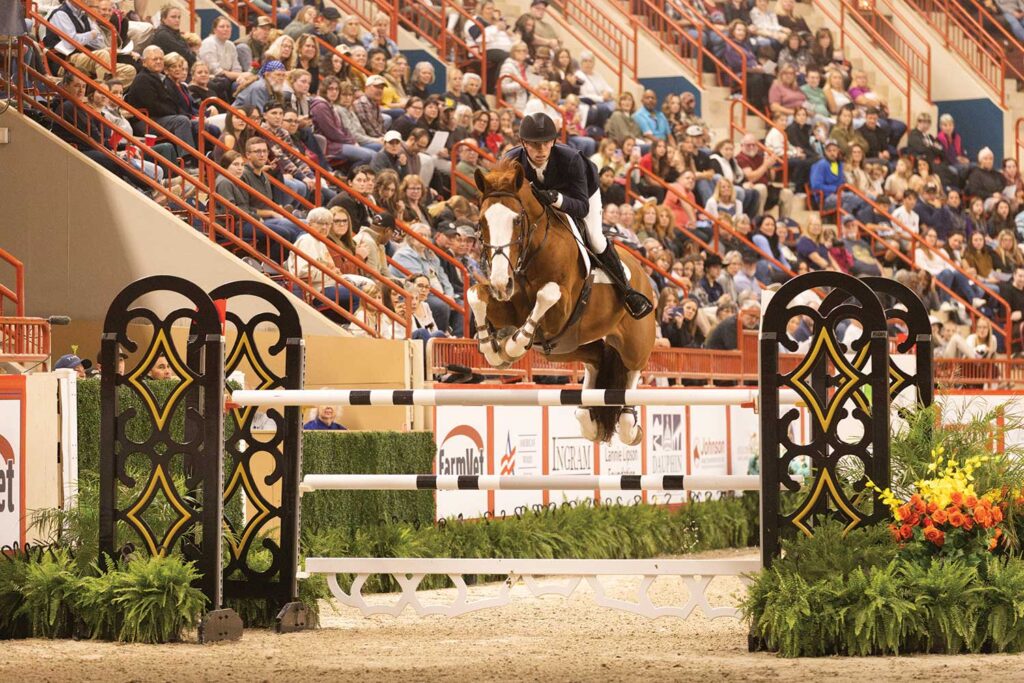
In October, the Harrisburg Coliseum changes character. The broad, workmanlike bowl inside the Pennsylvania Farm Show Complex becomes a theater: flowered jumps rise from carefully worked footing, golf carts and tack trunks thread the back aisles, and the walls seem to hold the names of Olympians and champions who trotted into the ring and into history.
For 11 days, “Harrisburg” becomes shorthand for one of American hunter-jumper sport’s essential tests. It is both a destination and a proving ground—a place where a pony rider can win a first national tricolor, a junior can confront the most consequential equitation course of her young career, and an open jumper can gallop for a grand prix beneath the same roof.
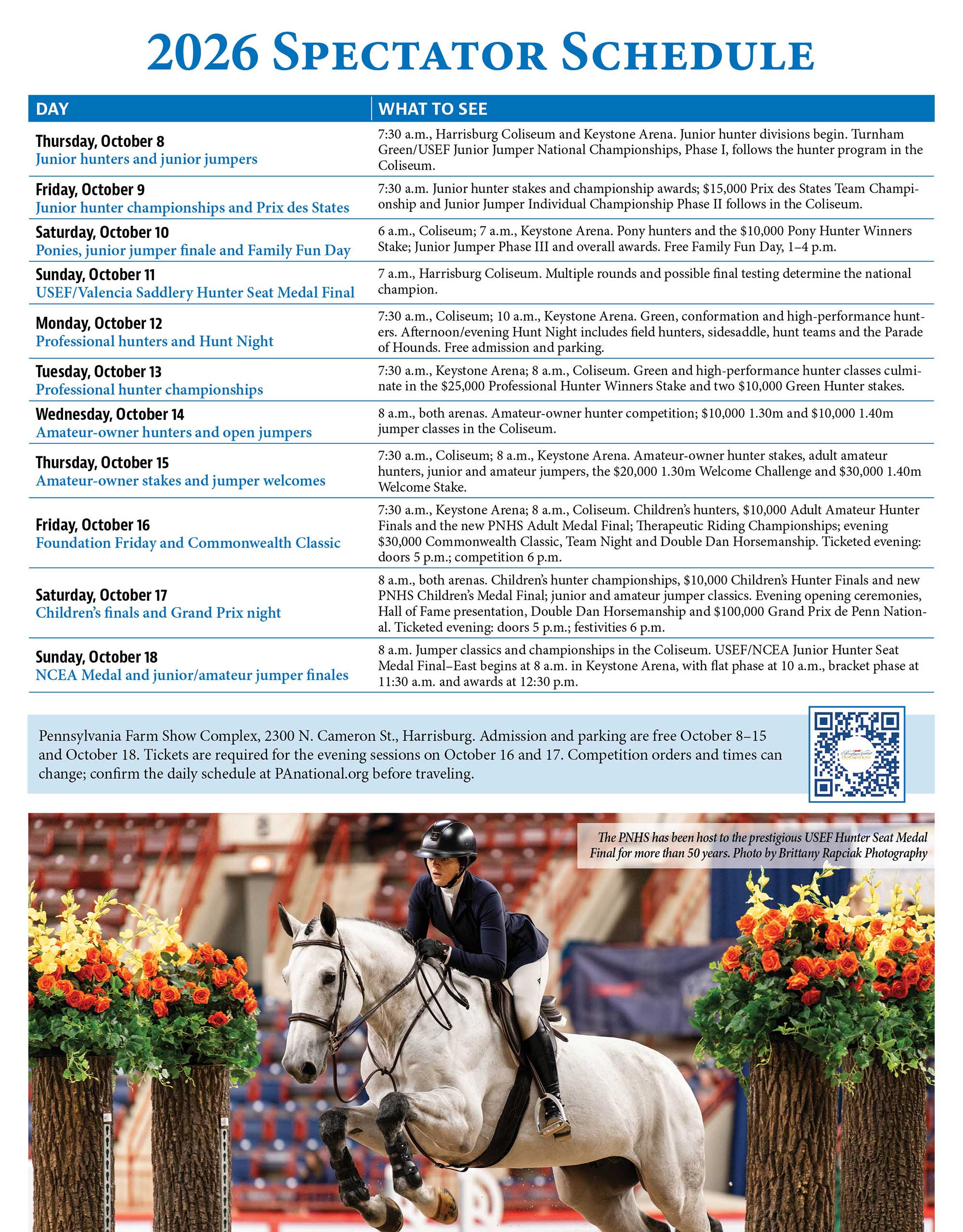
The Pennsylvania National Horse Show returns October 8–18 for its 80th edition. That milestone gives the 2026 show a natural air of celebration, but the better reason to go is simpler: few championships of this caliber remain so easy for a regional audience to enter. Admission and parking are free on nine of the show’s 11 days. You can arrive on a weekday morning, walk into the Coliseum and watch elite professional hunters without buying a ticket. Families can build a Saturday around ponies and free activities. Foxhunters can hear hounds speak in the ring on Monday night. Only the two marquee jumper evenings, October 16 and 17, require tickets.
That accessibility is not incidental to the show’s history. The first Pennsylvania National was held at the Farm Show Complex in 1946 as a four-day, 226-horse benefit for the Harrisburg Kiwanis Youth Foundation. International teams competed here from 1948 through 1972, and the show lengthened as its stature and entries grew: seven days in 1950, eight in 1962, nine in 1970, 10 in 1982 and 11 beginning in 2023. Today it draws roughly 1,200 horses and carries US Equestrian’s Heritage Competition designation, reserved for long-running events that have helped shape the sport.
Where a season comes into focus
Pennsylvania National sits in the heart of the East Coast indoor championship season, after Capital Challenge and immediately before the Washington International Horse Show. By October, the broad outdoor season has narrowed. Qualifying points have been counted, horses have been carefully aimed, and small errors matter more. Indoors, the walls arrive quickly, turns are compressed and atmosphere becomes part of the question.
The first four days belong largely to juniors and ponies. Junior hunters open the show October 8 and 9, sharing the early program with the Turnham Green/USEF Junior Jumper National Championships. The jumper championship is unusually instructive for spectators because it borrows the language of international team sport: riders represent USEF zones, contest three phases, and meet in the Prix des States team competition as well as the individual championship. These are not simply fast classes. Riders must produce repeatable rounds across several days, managing horse and pressure in a format meant to identify the next generation.
That feels especially timely in 2026. Several of the young Americans prominent in the national equitation and jumper ranks spent late summer preparing to represent the United States in European youth competition. The cross-pollination is visible at Harrisburg: a junior may ride a polished hunter in the morning, face a technical equitation test on Sunday and also bring the pace and decision-making of the jumper ring. Names such as JJ Torano, Brooke Hagerty, Parker Peacock and Violet Tatum have been conspicuous in major junior standings or U.S. youth selections this year; the final Harrisburg entry list will determine whom spectators actually see.
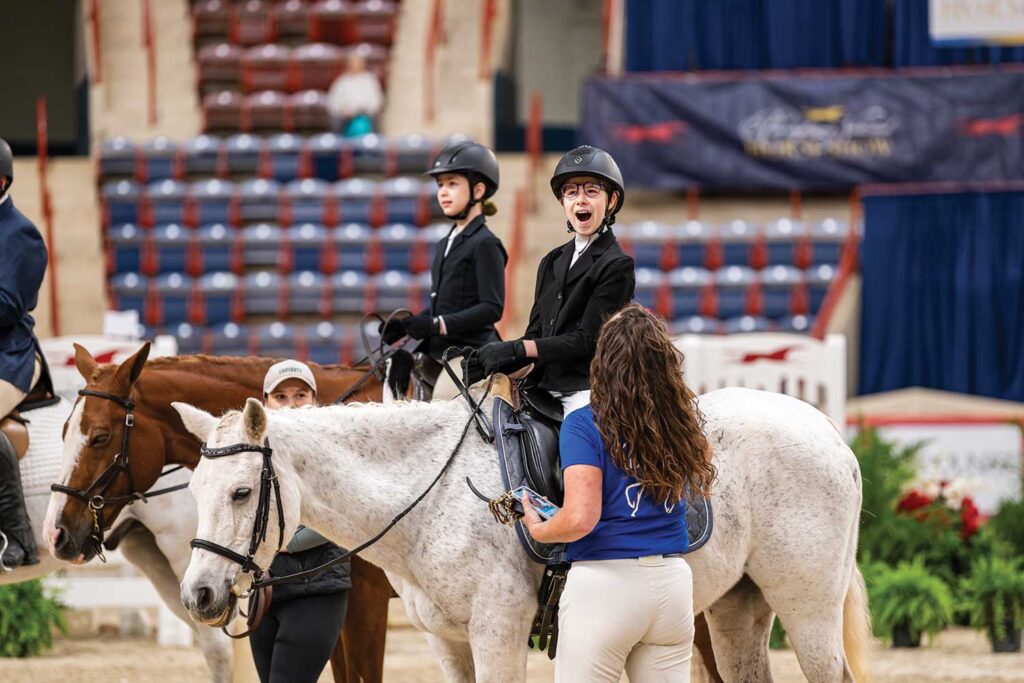
Saturday, October 10, brings pony hunters into the Coliseum and concludes the junior jumper championship. For non-specialists, pony day is an easy place to begin. The animals get larger as the divisions progress from small to medium to large, but the standard remains the same: rhythm, manners, jumping style and an apparently effortless trip. The $10,000 Pony Hunter Winners Stake gathers qualified performers for a final head-to-head class.
The Medal’s long shadow
Sunday, October 11, is devoted to the USEF/Valencia Saddlery Hunter Seat Medal Final, and it is difficult to overstate what that class means within American equitation. The final moved to Harrisburg in 1968 and has remained here ever since. Its winners’ list reads like a compressed history of the sport, including Bernie Traurig, Conrad Homfeld, Katie Monahan Prudent and Kent Farrington—riders who later became Olympians, championship team members and influential trainers.
Every qualified rider tackles the first-round course at 3-foot-6. Judges call back a smaller group for a second round and may ask the leading riders to perform a final test. That test can expose the fine print of horsemanship: counter-cantered fences, a trot jump, a hand gallop, a shortened track or a swap of horses. The winner is not necessarily the rider with the prettiest single trip, but the one who can solve a sequence of different questions while preserving the horse’s confidence and balance.
Last year offered a nearly perfect illustration. Olivia Sweetnam entered her fourth Medal Final after finishing fourth in 2023 and fifth in 2024. Riding Efendi, the seasoned Holsteiner she had once watched carry Brian Moggre to the same title, Sweetnam advanced from a field of 157 and delivered when the final test asked for two counter-cantered fences, a trot fence and a hand gallop. The story was not just persistence, but partnership across generations: an experienced equitation horse giving another young rider the education and confidence to finish the job.
Sweetnam’s victory also opened the door for a new class in 2026. Sunday’s winner will inherit a title held by riders who helped define American show jumping, while the newly sponsored final itself begins a fresh chapter under Valencia Saddlery. For spectators who want to see the sport’s future before the résumés are written, this is the day.
Hunters, hounds, and a broader front door
When junior weekend closes, the emphasis shifts. Professional hunters take the Coliseum on Monday and Tuesday, followed by amateur-owner hunters and then the adult and children’s divisions. Hunters are judged rather than timed: the ideal round is smooth, balanced and consistent, with an even pace and a horse that jumps in good style. The apparent simplicity is the point. At this level, the work is concealed.
PNHS has put additional weight behind those divisions in 2026. The show says it has added more than $100,000 in hunter prize money and doubled the Leading Hunter Trainer awards from $20,000 to $40,000. The schedule includes a $25,000 Professional Hunter Winners Stake; $10,000 stakes for green, junior, amateur-owner, adult amateur and children’s hunters; and new PNHS Adult and Children’s Medal Finals at 3 feet. Those new medals matter because they widen the championship doorway beyond the traditional junior equitation pipeline. Adult amateurs and children can now finish their Harrisburg week with a dedicated final of their own.
The money gives nearly every section a finale with consequence. Junior hunters and pony hunters each ride for $10,000 Winners Stakes; the professional hunters meet for $25,000; and the green, amateur-owner, adult amateur and children’s programs each culminate in five-figure classes. Behind the rail, the $40,000 trainer pool recognizes the less visible season-long work of producing those rounds. A Harrisburg ribbon has always carried prestige; in 2026, more of the prize list carries a purse to match it.
The professional division will also have a 2025 benchmark to chase. Clear As Day, shown by Kate Conover, won four classes and a second in Green Conformation on the way to both Grand Green and Grand Hunter honors. In the juniors, Brooke Hagerty and Casino Cash improved from reserve in 2024 to the 2025 3-foot-6 Grand Junior Hunter championship—a useful reminder that indoor success is often built over repeated attempts, not manufactured in one autumn.
Monday evening’s Hunt Night provides the show’s most distinctly regional change of tempo. Field hunters, sidesaddle riders and teams from more than a dozen hunts compete, and the Parade of Hounds brings living foxhunting tradition into the arena. It is formal without being remote, and admission and parking are free. For readers who know the sport from hunt breakfasts, Pony Club or a day following hounds rather than rated-show scorecards, this may be the most immediately familiar night of the week.
Friday’s Foundation program broadens the picture again. The Therapeutic Riding Championships and Therapy Horse of the Year presentation place riders, volunteers and unusually patient horses in the same championship setting. The nonprofit PNHS Foundation supports equine rescue and therapeutic-riding organizations; the program is not an intermission from the “real” horse show, but one expression of the show’s original charitable purpose.
Speed at the finish
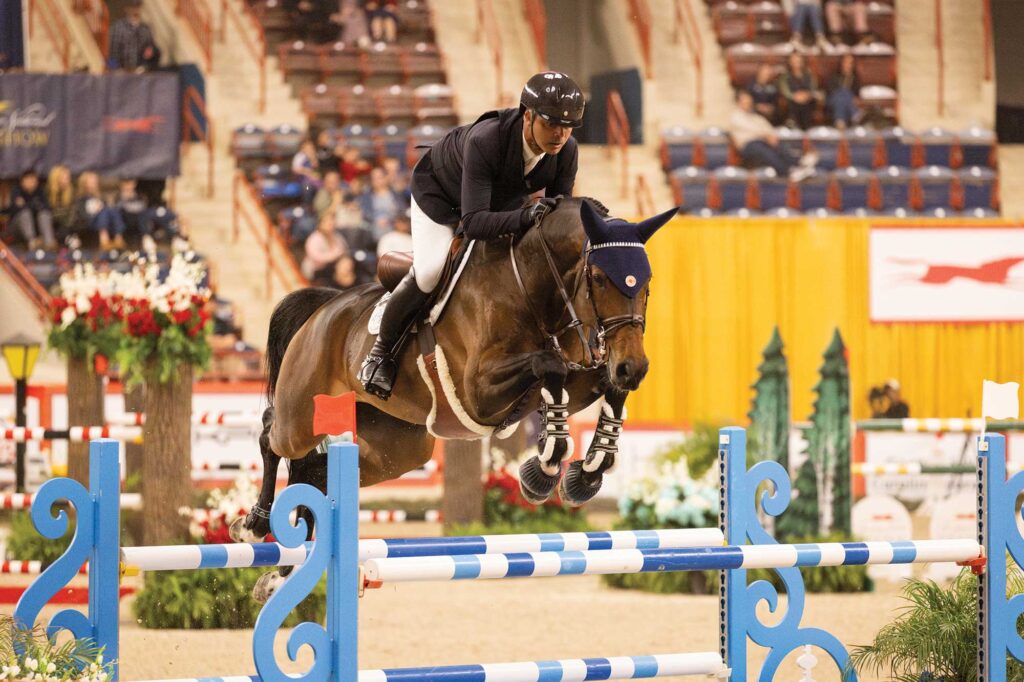
Jumpers take over the final stretch. Unlike hunters, jumpers are judged objectively: leave the rails up, stay inside the time allowed and, when a jump-off is offered, find the fastest clean route. The divisions build from junior and amateur classics through two headline nights.
The open program offers $140,000 across the 1.40-meter section, capped by the $100,000 Grand Prix, while the 1.30-meter division puts $60,000 in play across a $10,000 speed class, $20,000 Welcome Challenge and $30,000 Commonwealth Classic. Harrisburg has attracted Olympic champions and international names including Brazil’s Rodrigo Pessoa—twice a winner of the Grand Prix de Penn National—and McLain Ward, who beat Pessoa by roughly two-tenths of a second for the 2022 title aboard First Lady. Alex Matz is among the accomplished American riders photographed in recent open-jumper competition. None should be treated as a confirmed 2026 entry until the accepted list is released, but those names define the level of riding the class has historically drawn.
On Friday, October 16, the $30,000 Commonwealth Classic is a 1.30-meter grand prix paired with Team Night and a performance by Dan James of Double Dan Horsemanship. It is the more casual of the two ticketed evenings and a smart introduction for barn groups or families who want speed and spectacle without the Saturday-night price.
Saturday’s $100,000 Grand Prix de Penn National is the show’s finale under the lights, with fences listed at 1.45 to 1.50 meters. A first-round course filters the field; riders who are clear return for a shortened jump-off where fractions of a second and the angle to a fence can reorder the result.
In 2025, first-time Harrisburg competitor Matthew Boddy produced the week’s best finish with Keatingstown Miami. Only four of 24 combinations advanced to the jump-off, and none went clean a second time. Boddy and the expressive Belgian Warmblood mare were fastest among the four-fault rounds, edging Laura Chapot and C&C Willow. Miami had first been ridden by Boddy’s wife, Taylor, and the win came with Taylor and the couple’s newborn son watching—a family horse delivering a career result on one of the sport’s old stages. If the pair returns, they will carry the rare and difficult task of defending it; if not, their 2025 win remains the right kind of Harrisburg story, where arrival and belonging can happen in the same night.
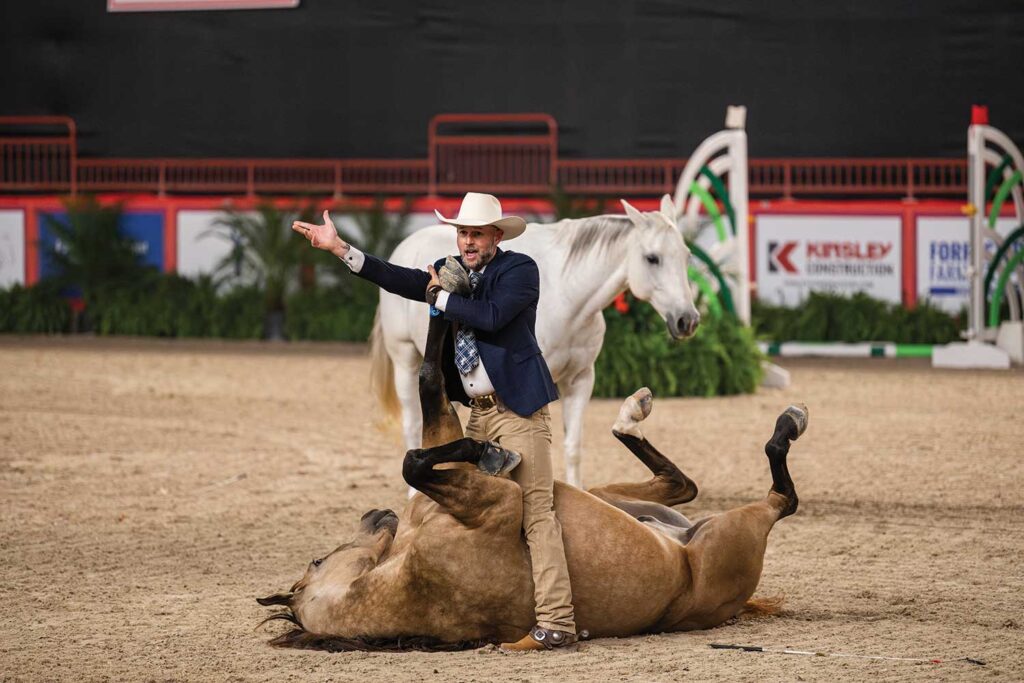
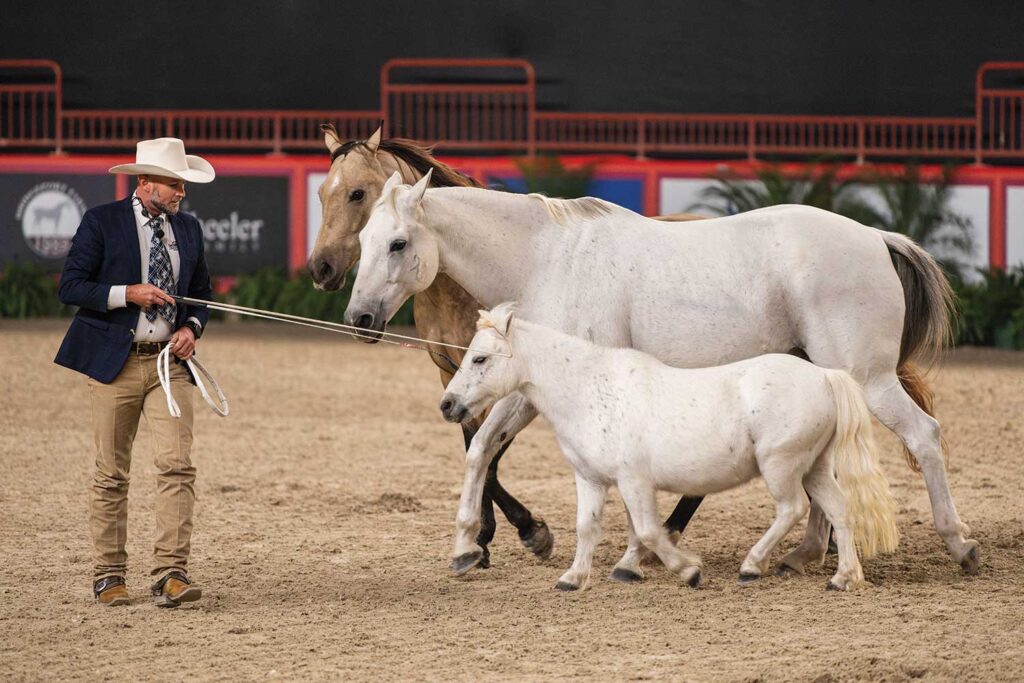
Dan James returns during both Friday and Saturday evenings, offering a different kind of mastery between jumper classes: liberty work and horsemanship built on communication rather than the clock. After Saturday’s grand prix, an autograph session gives young fans a chance to meet the riders they have just watched.
There may be grander venues and richer classes on the modern calendar. Harrisburg’s hold on the sport comes from accumulation: 80 years of junior nerves, polished hunters, rails that stayed up and rails that did not; of hounds in the Coliseum and children leaning over the rail; of horses whose names remain on trophies long after their last round. The anniversary matters because the show has endured. The invitation matters because, for most of its 11 days, anyone can come inside and see why.