


The Making of a Renaissance Horsewoman
In a world of specialists, Kirsten Moore brings mind, body and spirit together across disciplines—the knowledge to understand the horse, the physical skill to communicate clearly and the intuition to earn its trust.
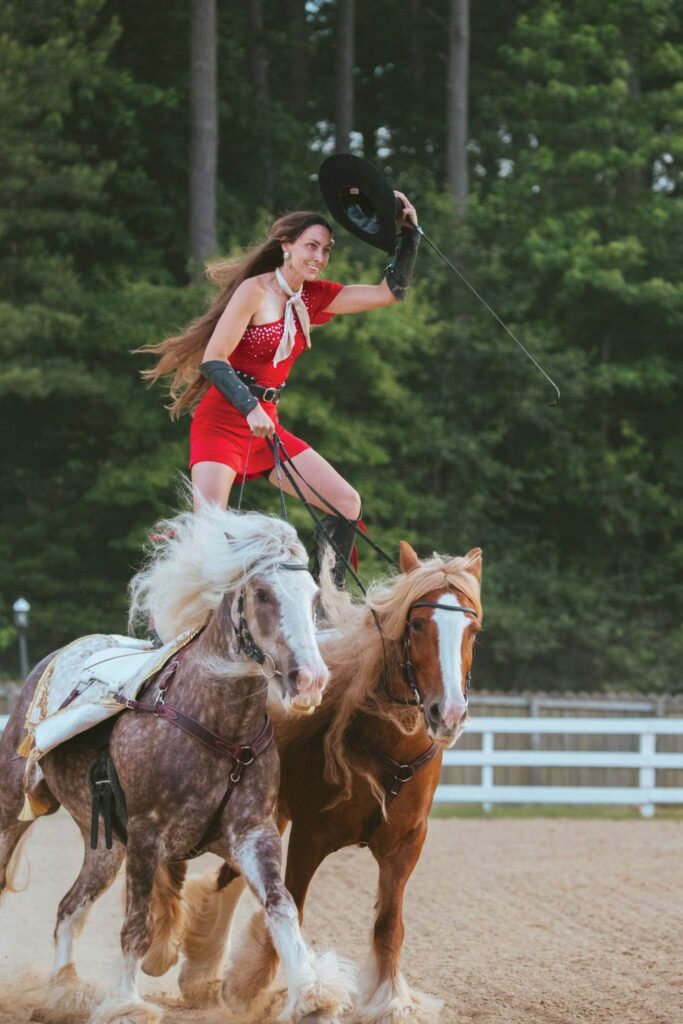
At first glance, Kirsten Moore might seem like a throwback: a horsewoman shaped not by one discipline, but by many. Yet at 34, she represents something decidedly modern—a return to broad horsemanship grounded in curiosity, practiced skill and attention to the individual horse.
Moore is a trainer, performer, trick rider and farrier whose experience spans classical dressage, driving, liberty work, Roman riding, recreational vaulting, breeding, young-horse development, warmblood handling and showing, and farriery. She has driven Friesians, ridden Andalusians, managed a Gypsy Vanner breeding farm, started young warmbloods and shown foals as well as presenting them inspections. Alongside that work, she teaches, performs and maintains an equine art practice encompassing painting, sculpture, woodcarving, beadwork and horsehair braiding. The pursuits may seem disparate, but together they form the architecture of a modern equestrian renaissance. The range is unusual; the philosophy behind it is consistent. Her work draws on mind, body and spirit: the theory required to understand a horse, the physical skill to communicate clearly, and the intuition to recognize when a horse is ready to trust.
If Moore’s instinct with horses seems innate, the breadth of her horsemanship was forged along the path she began early and spent a lifetime of work creating—one horse, one discipline and one hard-won lesson at a time.
She began riding at about 9. A year later, her parents bought her a horse, and by 11 she was charging friends $5 for lessons. After reading Walter Farley’s “The Black Stallion,” she became determined to own an Arabian. At 14, she bought one who tested that ambition.
“He threw me off, skinned off the top of my foot and gave me a concussion, but not enough to stop me,” she said. “I would pretend it wasn’t the horse who had hurt me, so my mom wouldn’t know.” She persisted, eventually selling him for three times what she had paid.
“After that I just thought I was a trainer,” she said. “I started training horses for other people.”
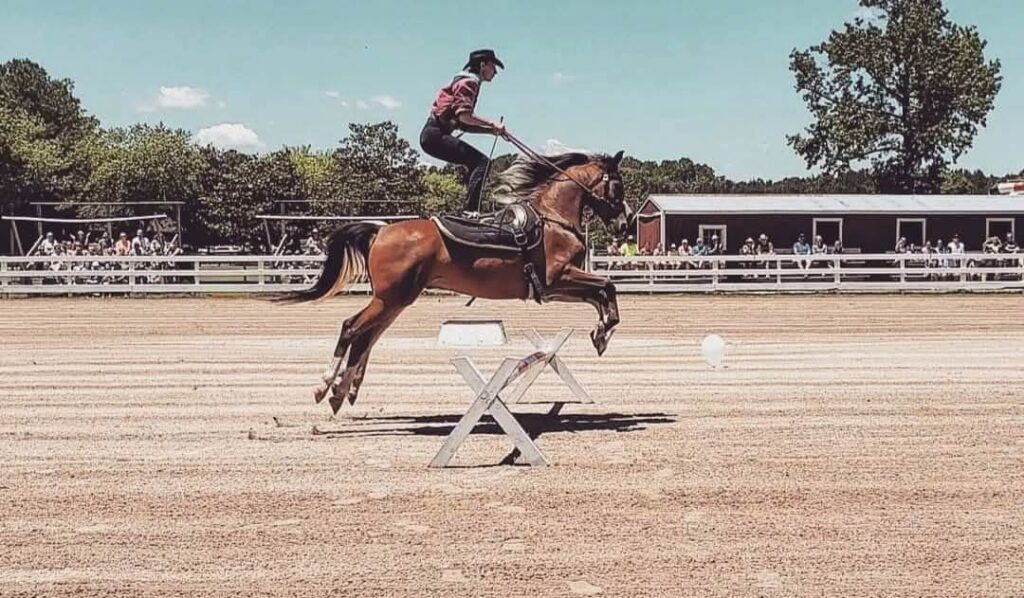
What followed was an education assembled horse by horse, each experience adding another layer to the way she read them. Then, at 18, Moore saw J.D. Windslow performing Roman riding at the Delaware State Fair. She sought out trainer Tommie Turvey and learned Roman riding, trick riding and liberty work—work requiring athleticism, precision and a keen sense of a horse’s attention.
At 21, she wintered at the Dancing Horses Theater in Wisconsin, where she befriended trainer Desiree Herrmann. That summer, she worked at Frontier Town Adventure Park near Ocean City and met her future husband, John. His Cherokee and Waccamaw Sioux family has been part of Frontier Town since it opened in 1960.
The following year, Moore joined Herrmann at a Florida dressage barn, bringing four horses. There she learned to drive Friesians and rode Andalusians in classical dressage. Two years later, she and John moved to Bit N Heaven Stables, Mike Nenni’s Gypsy Vanner breeding operation, where Moore became head trainer and manager.
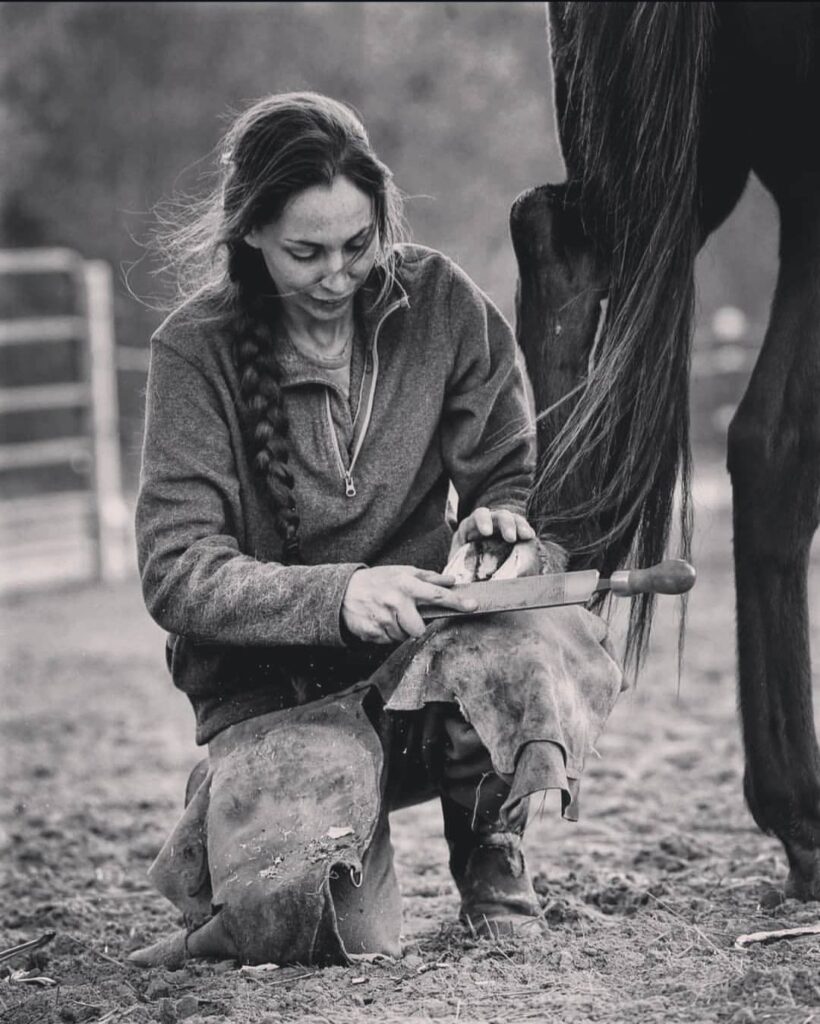
Her farrier work developed through necessity and apprenticeship. She had learned to trim her own horse’s feet to save money. In Florida, farrier Andy Gumpert taught her more and relied on her in emergencies.
“When the Friesians would lose their shoes, I could tack them back on to hold until he came back,” she said.
The work deepened her understanding from the ground up. Hooves revealed what riding could conceal: imbalance, compensation, soreness and small changes affecting a horse’s willingness to move. What she learned with a rasp informed what she felt from the saddle.
About nine years ago, Moore returned to Maryland’s Eastern Shore where today she trims roughly 400 horses in rotation while continuing to train, teach and perform. In 2020, she returned to Frontier Town near Ocean City as a Roman rider in a show produced by Austin Anderson of Austin Anderson’s Texas Trick Riders. Anderson said her willingness to extend herself into liberty work and other new areas made her a natural fit. Moore performs Mondays and Tuesdays; John appears in the Native American show, and their children, now 7 and 5, perform tricks with their ponies.
“They were riding when they were in my belly,” Moore said. Family is a large part of the life she has built, not separate from it: performances, ponies, regalia and long days around horses are woven into its rhythm.
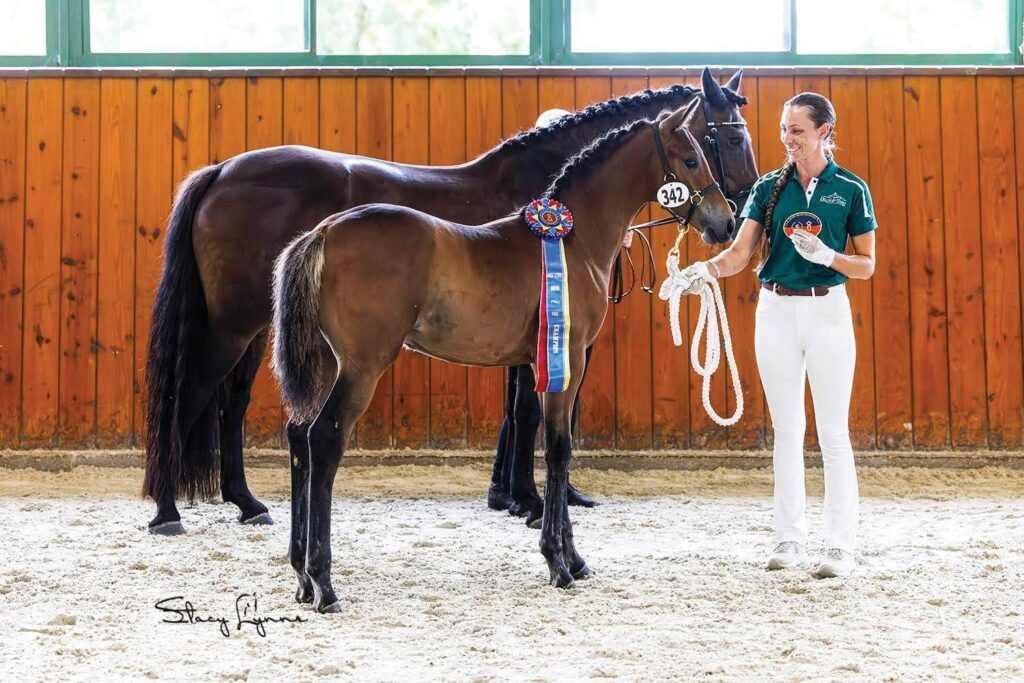
Her lessons are dressage-based, but the emphasis is broader.
“We do a lot on your relationship with your horse, what they are thinking, and how to react and interact with the horses,” she said. Her favorite class is recreational vaulting. (Did we remember to add vaulting to the list?)
Moore wants students to understand why a horse responds, not merely how to produce a response. Position and timing matter, but so do restraint and judgment. Among her current clients are two young warmbloods.
“When I get a 3- or 4-year-old, I absolutely love the process of teaching them everything they will need to know to get along in life,” she said. “When it clicks, it is such a great feeling.”
Starting a young horse brings her approach together: knowledge of development, physical clarity, and the moment apprehension gives way to comprehension. For Moore, connection is a practical necessity; trust changes what a horse can learn.
Her visual art grew from the same hands-on instinct. Moore and her siblings studied art while being homeschooled; her older sister, Jenell Hartell, is a professional portrait artist. She works in painting, drawing, sculpture, mosaic, beadwork and woodcarving. Moore makes John’s and their children’s Native regalia and creates “Spirit Ponies”—wooden memorial horses painted to resemble a client’s horse and finished with strands of its mane and tail. Kirsten teaches Victorian hair braiding, turning horsehair into jewelry and hatbands, and repairs the crackers on bullwhips used by Saltwater Cowboys during the Chincoteague Pony roundup.
Monica Shubert, manager of the Chincoteague Pony Centre, met Moore at 10 and remembers her feel for horses and work ethic. Moore later helped the family address challenges with young foals and establish stronger herd foundations.
“Kirsten’s approach to natural horsemanship emphasized trust, communication and understanding the horse as an individual,” Shubert said. “Although I had owned and worked with horses for most of my life, I found myself learning from her.”
Shubert said those principles remain embedded in the center’s programs today.
For the Frontier Town show schedule, visit frontiertownadventurepark.com/western-experience.